



The Parking & Electric Future Investigation — Part 2: Charging Nowhere
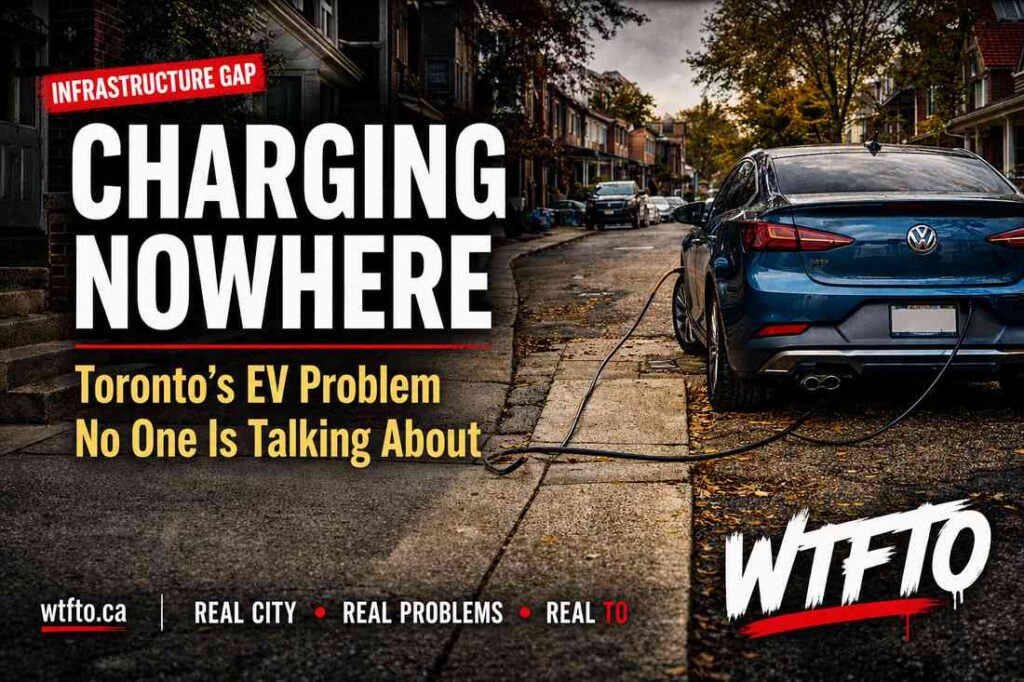
Toronto has made its ambitions clear. The city has declared a climate emergency, promoted electric vehicles as a central part of its long-term emissions strategy, and encouraged residents to prepare for a future where gasoline-powered cars gradually disappear from the streets.
On paper, the transition appears straightforward. Electric vehicles produce fewer emissions, charging technology continues to improve, and governments at every level are offering incentives to accelerate adoption.
But when that future meets the physical reality of Toronto’s streets, a basic question begins to emerge.
Where exactly will the cars plug in?
Because while electric vehicles are often discussed in terms of technology and climate policy, the shift to EVs ultimately depends on something far more mundane:
A place to charge.
And for a significant portion of Toronto residents, that simple requirement is far from guaranteed.
The Charging Assumption
Much of the public conversation about electric vehicles assumes that drivers will charge their cars at home.
For suburban homeowners with private driveways or garages, this assumption makes sense. Installing a residential Level 2 charger is relatively straightforward. An electrician connects the charger to the home’s electrical panel, the vehicle plugs in overnight, and the car begins each morning fully charged.
In many parts of Canada and the United States, this model works well.
But Toronto is not a typical suburban landscape.
Large portions of the city were built long before private driveways were standard features of residential design. Entire neighbourhoods — particularly in older parts of the city — rely heavily on street parking.
For these residents, the assumption of home charging quickly breaks down.
You can’t plug in a car when the car is parked half a block away.
Life on the Curb
In neighbourhoods like Riverdale, the Junction, Parkdale, and parts of the Danforth, street permit parking remains the primary option for thousands of households.
Cars line both sides of residential streets overnight. In many cases, the same limited spaces are shared among dozens of homes.
For drivers considering an electric vehicle, this creates an immediate problem.
Unlike gasoline vehicles, which can refuel anywhere a gas station exists, electric vehicles depend on access to electricity — and electricity requires infrastructure.
That infrastructure is easy to install when the car sits in a private driveway.
It becomes far more complicated when the car sits on a public street.
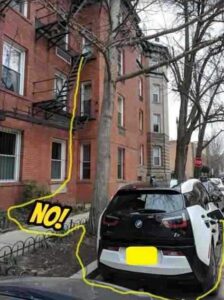
Some EV owners have attempted workarounds. In a few neighbourhoods, residents have experimented with running extension cords from their homes across sidewalks to charge vehicles parked at the curb.
But this approach introduces obvious safety concerns.
Loose cables across pedestrian walkways create tripping hazards, interfere with accessibility for mobility devices and strollers, and raise questions about electrical safety and liability.
Not surprisingly, city bylaws generally prohibit the practice.
Which leaves many residents with a simple dilemma:
They may want to switch to electric vehicles — but they have nowhere to charge them.
The Missing Infrastructure
Toronto does have public charging stations.
They can be found in parking garages, shopping centres, and select curbside locations across the city.
But the number of chargers remains relatively small compared to the number of vehicles on Toronto’s roads.
Public chargers also introduce practical limitations. Charging an electric vehicle can take anywhere from 30 minutes on a high-speed fast charger to several hours on a standard Level 2 unit.
Unlike gasoline refueling, which takes minutes, EV charging often requires drivers to leave their vehicles connected for extended periods.
This works reasonably well when charging happens overnight at home.
It becomes far less convenient when drivers must travel across neighbourhoods searching for available chargers.
In dense urban areas, the experience can begin to resemble another familiar Toronto routine:
Circling the block.
Only this time, drivers aren’t looking for parking.
They’re looking for electricity.
The Front Yard Question Returns
This is where Toronto’s front yard parking rules quietly re-enter the conversation.
For homeowners who already have private driveways, installing a charger is a manageable step in the transition to electric vehicles.
But for homeowners in older neighbourhoods — the same areas discussed in The Driveway Lottery — the situation can look very different.
Many of these homes have no driveways, no rear laneways, and no off-street parking of any kind.
And in many cases, city bylaws prevent residents from even applying to create a small front-yard parking space that could support home charging.
The result is an unusual policy contradiction.
The city encourages residents to adopt electric vehicles as part of its climate strategy.
Yet the same regulatory framework can prevent thousands of homeowners from creating the basic infrastructure needed to support that transition.
A Policy Gap Few People Are Talking About
Urban planners often talk about the importance of aligning infrastructure, transportation policy, and environmental goals.
In theory, these systems should reinforce one another.
In practice, Toronto’s transition toward electric vehicles reveals a growing gap between policy ambitions and physical reality.
The city is encouraging residents to embrace electric transportation.
But much of the infrastructure required to support that transition — particularly in older neighbourhoods — simply does not exist yet.
For residents without driveways, the path to electric vehicle ownership remains uncertain.
And unless new charging solutions emerge for street-parked vehicles, that gap may become increasingly difficult to ignore.
The Larger Question
Electric vehicles are often presented as a key component of Toronto’s climate strategy.
But the shift from gasoline to electricity involves more than replacing one type of engine with another.
It requires a fundamental change in how cities think about energy infrastructure.
Gas stations are visible, centralized, and widely distributed.
Electric charging, by contrast, is decentralized. It depends on thousands of small charging points embedded throughout neighbourhoods, homes, and parking spaces.
For cities built around private driveways, this transition may be relatively manageable.
For cities built around street parking, the challenge is far more complex.
Which leads to a question that Toronto is only beginning to confront.
If the city is serious about an electric future, where exactly will the electricity come from — and where will the cars plug in?
Because solving the environmental challenge of transportation may ultimately require solving something far more practical first:
Where the car parks at night.
Bridge to Article 3
The city’s climate plans assume that electric vehicles will become increasingly common on Toronto’s roads in the years ahead.
But turning that vision into reality involves more than encouraging residents to buy electric cars.
It requires a massive expansion of charging infrastructure, upgrades to electrical systems, and a rethink of how energy is delivered across urban neighbourhoods.
In other words, the future of transportation may depend on something far bigger than parking bylaws.
It may depend on whether Toronto’s electrical grid — and its urban infrastructure — are ready for the shift.
That’s the question we explore next.
Great article, exactly the kind of straight talk Toronto needs.
I drive an electric car and park on the street, so this issue is very real for me. Within walking distance of my house there are four chargers. Sounds good, right? Not really, if I can find a charging spot it takes about 5-6 hours to charge, which means I often have to go move my car at 2 a.m.
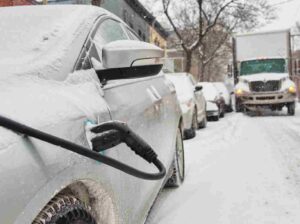
In the winter it gets worse. Snowbanks can block the charging spots entirely, sometimes leaving only one usable charger for my whole area. Also, those snowbanks can be the size of cars themselves taking up parking spots.
The EV future sounds great, but the reality of Toronto on-streets parking is a lot messier.
Remove the parking pad by-law Toronto!!
Thank you for the thoughtful comment. This is exactly the kind of real-world experience that often gets missed in policy talk. On paper, a few nearby chargers can sound like enough, but in practice, long charging times, overnight car moves, blocked spots, and winter snowbanks make the situation far more difficult. Toronto’s EV future only works if the day-to-day reality works too.