



The Parking & Electric Future Investigation — Part 3: Electric Future, Unequal Access
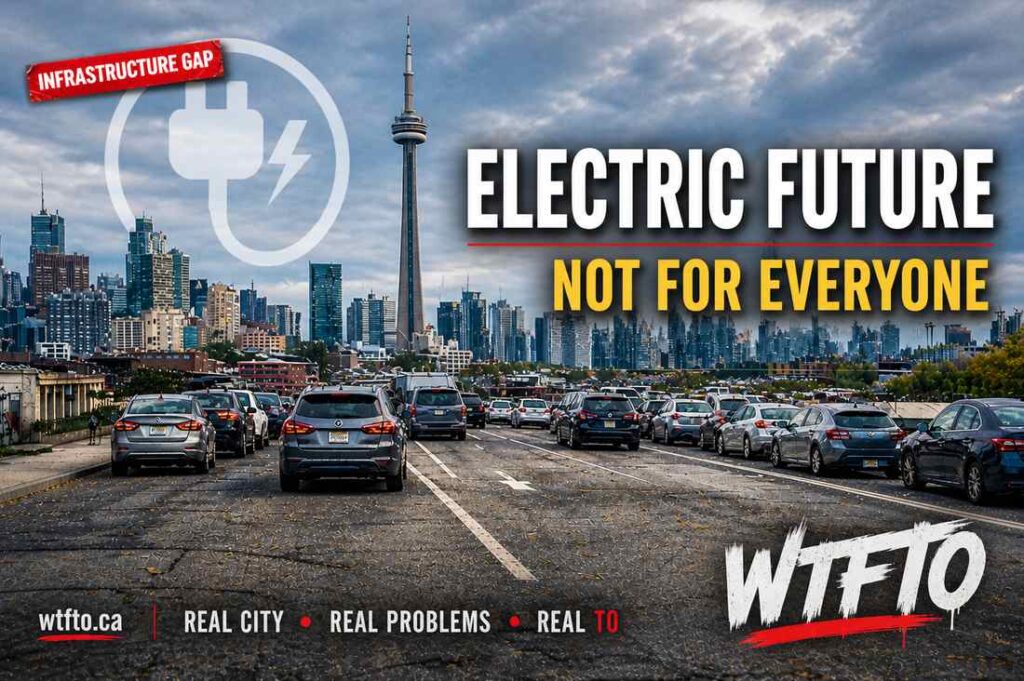
Toronto has declared a climate emergency. It tells residents the future is electric. Electric vehicles are promoted as a central part of the city’s long-term emissions strategy. Public charging networks are expanding. Infrastructure targets are published. Registration numbers continue to climb.
The message is clear: this is the direction the city is moving.
But step onto a quiet residential street in one of Toronto’s older neighbourhoods — Davenport, the Junction, Beaches–East York, the Danforth — and the electric future begins to look less certain.
These communities were built long before private driveways were standard. Homes sit close to the sidewalk. Lots are narrow. Cars line the curb overnight.
Street permit parking isn’t a choice.
It’s a necessity.
Which leads to a surprising reality.
You can buy an electric car tomorrow.
You just might not be able to legally charge it at home.
For thousands of Toronto households, the barrier is not technological. It’s not financial.
It’s regulatory.
The Map Behind the Message
Toronto’s EV strategy leans heavily on public infrastructure. Through the Toronto Parking Authority’s Green P network and other municipal programs, the city has installed hundreds of publicly accessible charging ports and announced plans for continued expansion.
On paper, the numbers look encouraging.
But infrastructure is not just about quantity.
It’s about geography.
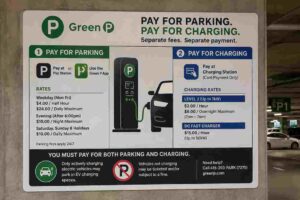
City reports show charging infrastructure clustered in specific areas — downtown districts, commercial zones, and major parking facilities. That means some neighbourhoods enjoy multiple nearby charging options, while others — particularly residential districts dominated by street parking — may have few or none within practical distance.
Public charging works well at destinations like shopping centres, civic buildings, and parking garages.
It does not reliably replace overnight residential charging.
And when that option doesn’t exist because a homeowner cannot legally create an off-street parking space, the gap becomes obvious.
That’s where a streetscape debate quietly becomes an infrastructure debate.
The Bylaw That Freezes Time
Front yard parking in Toronto is governed by Municipal Code Chapter 918, a regulation shaped in a very different planning era.
When the bylaw emerged, the concern was “cars on lawns.” Policymakers wanted to preserve green front yards, prevent excessive paving, and maintain neighbourhood character.
Those priorities shaped rules that still exist today — including non-acceptance provisions tied to legacy municipal geography.
The problem is that Toronto itself has changed.
The city now operates under a 25-ward system, adopted in 2018. But Chapter 918 still reflects older municipal boundaries and historic planning assumptions that pre-date amalgamation.
The result is a regulatory map that does not always align with today’s infrastructure realities.
In practice, this means that in some neighbourhoods — particularly dense central ones — homeowners face significant barriers when attempting to create off-street parking.
Meanwhile, in suburban wards where driveways were always part of the housing form, installing a home EV charger is usually simple.
The policy applies citywide.
The experience does not.
Davenport and Beaches–East York: A Case Study in Friction
Ward 9 (Davenport) and Ward 19 (Beaches–East York) highlight how neighbourhood design and legacy policy intersect.
Both wards contain older housing stock built long before private driveways became common. Lots are narrow. Homes are tightly spaced. Rear laneways are limited.
Street permit parking is the default.
These conditions make residents in these neighbourhoods among the least likely to have off-street parking.
Yet they are also the places where front-yard parking proposals face the most scrutiny.
Applications may trigger concerns over:
• tree root protection
• curb cuts removing street parking spaces
• impacts on neighbourhood character
Reviews can involve multiple departments, increasing uncertainty and delays.
And the proposals residents bring forward are often modest.
Not large driveways.
But small, engineered spaces designed to support Level 2 EV chargers.
A Tale of Two Homeowners
Consider two Toronto homeowners.
In Davenport, Mark lives in a semi-detached home built in the 1920s. There is no driveway. No garage. No laneway access. Street permit parking is his only option.
Mark wants to switch to an electric vehicle. The fuel savings make sense. The environmental benefits are clear.
But charging remains the obstacle.
The nearest public charger is several blocks away and frequently occupied overnight.
Mark explored installing a narrow permeable front-yard parking pad with a Level 2 charger.
The response highlighted familiar concerns: tree roots, curb cuts, and the loss of permit parking.
Approval would be difficult.
A few kilometres away in Scarborough, Sandra’s experience is completely different.
Her home already includes a driveway and garage. When she bought her electric vehicle, she hired an electrician to install a Level 2 charger.
Charging overnight became routine.
Both residents live in Toronto.

Both hear the same climate messaging encouraging EV adoption.
But the infrastructure supporting that transition is dramatically different.
The Environmental Argument — And the Inconsistency
Opposition to front yard parking is often framed around legitimate planning concerns:
• stormwater runoff
• tree root protection
• loss of green space
• neighbourhood character
These are real environmental issues.
But the inconsistency appears when these concerns are compared with other forms of development Toronto actively permits.
The city routinely approves:
• laneway suites
• garden suites
• multiplex conversions
• intensification projects
All of these increase lot coverage and introduce impermeable surfaces.
Yet mitigation measures — permeable paving, landscaping ratios, drainage engineering, and tree protection requirements — are considered sufficient to manage environmental impact.
The tools exist.
Toronto uses them.
When the goal is housing supply, engineering becomes the solution.
When the goal is residential EV charging, geography often becomes the barrier.
The contradiction is not technological.
It is regulatory.
Toronto says the future is electric.
But the rules governing its streets still belong to another era.
0 Comments
be respectfulNo comments yet. Start the discussion.