



Toronto Took 40 Years to Build a Subway — Then Acted Like It Was Obvious All Along
Toronto’s first subway didn’t start in 1954. It started in 1909 — when the city was first told it needed one. Back…
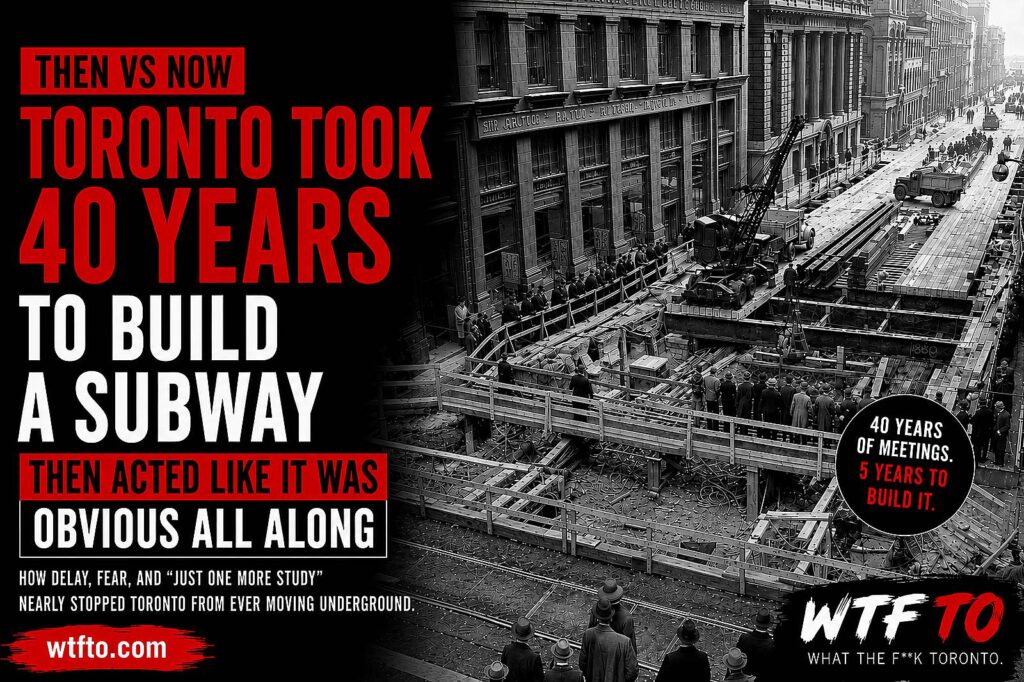
Toronto’s first subway didn’t start in 1954.
It started in 1909 — when the city was first told it needed one.
Back then, a British-backed group pitched the idea of underground transit along Yonge Street. It wasn’t radical. London had already done it. New York had already done it. Boston had already done it.
Toronto had meetings.
And not just one or two.
Committees were formed. Reports were commissioned. Experts were brought in, listened to, and then quietly ignored. The idea of a subway kept resurfacing, getting close enough to feel real — and then drifting back into discussion.
Plans were drawn. Consultants warned that congestion would become a serious problem. Business leaders pushed for better access to downtown. The idea never really went away.
It just never really moved.
For decades, Toronto convinced itself it didn’t need a subway. The city already had one of the largest streetcar systems in the world, and the thinking was simple: why spend millions digging underground when you can just run more streetcars?
It sounded reasonable.
It wasn’t.
There was only one problem.
You can’t run more vehicles on a street that’s already full.
And even then, the instinct wasn’t to act.
It was to study the problem again.
Still, no subway.
World War II put everything on hold. Construction stopped. Materials were diverted. The city waited again.
But when the war ended, Toronto didn’t return to what it was before. It grew fast. Population surged. Suburbs expanded. More people needed to get into the core every single day — and the system that already wasn’t working had to carry even more.
That’s when the conversation changed.
Not because the city suddenly became visionary. Because it ran out of room to pretend.
Downtown businesses were feeling it. Workers were feeling it. Delays weren’t theoretical anymore — they were daily.
The TTC wasn’t guessing. It was measuring.
And what it saw was simple: the system had hit a ceiling.
No amount of scheduling tweaks, added vehicles, or minor improvements could fix it. Surface transit had reached its physical limit. The problem wasn’t inefficiency anymore.
It was capacity.
This wasn’t about ambition anymore.
It was about survival.
The TTC began pushing harder. Studies became clearer. The message got simpler: there was no version of the future where Yonge Street kept working like this.
There was only one option left.
In 1946, after decades of delay, the city finally put the question directly to voters.
The answer wasn’t cautious. It wasn’t divided. It wasn’t even close.
Toronto voted yes to a subway by a landslide — nearly 90 percent.
After forty years of hesitation, the public didn’t hesitate at all.
Which says more about the delay than the decision.
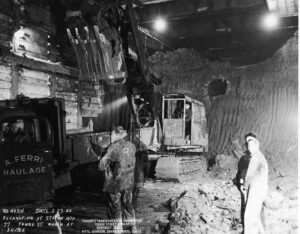
Construction started in 1949. And when it did, it wasn’t subtle. Yonge Street was ripped open. Entire sections of the city were disrupted. The solution that had been debated for decades arrived all at once, loudly and visibly.
Five years later, in 1954, Canada’s first subway opened beneath Yonge Street.
And just like that, the thing that had been debated for decades became something the city couldn’t imagine living without.
That’s the part Toronto doesn’t like to talk about.
Because the lesson isn’t that the city was bold.
It’s that the city waited until it didn’t have a choice.
There was no defining moment of vision. No sudden burst of leadership. No clean, confident decision made early.
There was pressure. There was crowding. There was a system that stopped working.
And eventually, there was nowhere left to hide from it.
That’s what forced the subway.
Not corruption. Not a grand plan. Not a private takeover.
Just a city that ran out of ways to delay the obvious.
And if that sounds familiar, it should.
Because Toronto still does this.
Different projects. Different names. Same pattern.
Debate stretches for years. Plans shift. Costs rise. Decisions get pushed forward, then backward, then sideways. Everything gets studied. Everything gets reconsidered. Everything gets delayed just long enough to feel responsible.
But that’s not caution.
It’s a habit.
A fear of committing to big infrastructure.
So the cycle repeats itself, over and over again:
Study. Delay. Debate. Redesign. Restart. Repeat.
Everything gets examined. Everything gets reconsidered. Everything gets pushed just far enough into the future to feel responsible — without actually committing to anything.
Until it doesn’t.
Until something breaks.
Until the pressure builds to the point where doing nothing becomes more dangerous than doing something.
That’s when Toronto moves.
Not at the beginning of the problem.
At the end of it.
The first subway wasn’t built because the city was ahead of its time.
It was built because the city finally ran out of time.
And today, for all the talk about progress and planning and learning from the past, that part hasn’t changed nearly as much as people think.
 review
When I originally commented I clicked the “Notify me when new comments are added” checkbox and now each
time a comment is added I get three e-mails with the
same comment. Is there any way you can remove me from that service?
Appreciate it!
You have made some good points there. I checked on the internet to
find out more about the issue and found most individuals will go along with your views on this site.
I really like what you guys are usually up too. This sort of clever work and reporting!
Keep up the great works guys I’ve added you guys to my personal blogroll.
This is really interesting, You are a very skilled blogger.
I have joined your feed and look forward to seeking more of your magnificent post.
Also, I have shared your web site in my social networks!
Wonderful beat ! I wish to apprentice at the same time as you amend your website,
how can i subscribe for a weblog site? The account helped
me a acceptable deal. I were tiny bit acquainted of this your broadcast provided vivid transparent concept