



Building Toronto — When the City Built Without Looking Back
There was a time when Toronto didn’t spend years deciding what to build. It just built it — and you could watch…
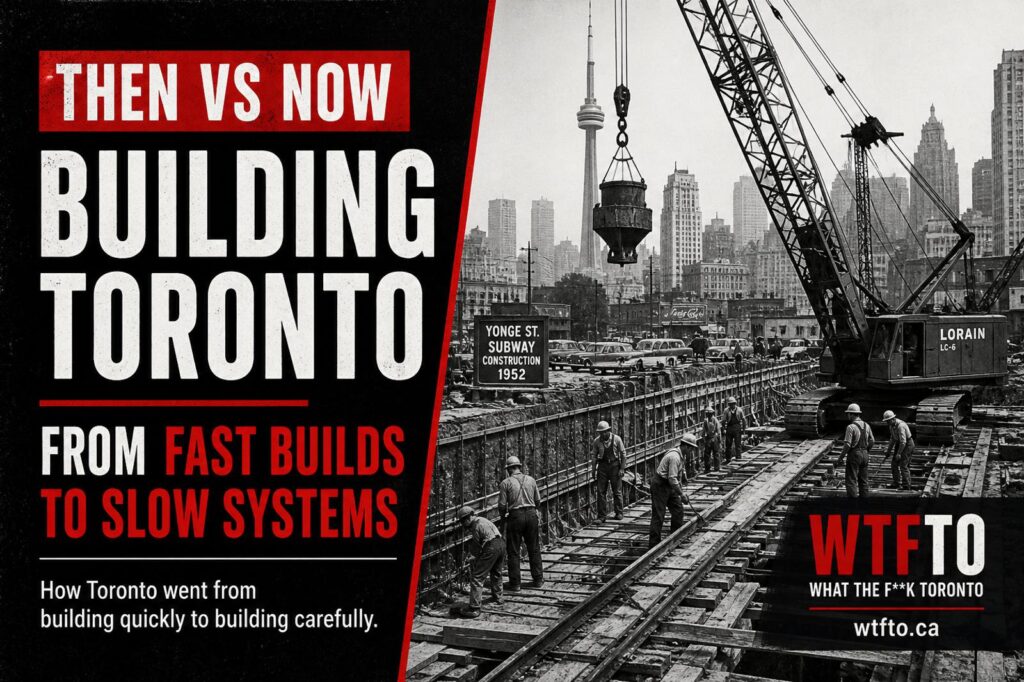
There was a time when Toronto didn’t spend years deciding what to build. It just built it — and you could watch it happen.
There was a different kind of pace to Toronto once not rushed, but direct. You could feel it in the streets. Something would begin, and from that point forward, it moved. Fences would go up, crews would arrive, and within weeks there would be visible change. Steel rising where there had been empty space. Concrete curing where there had been dirt. The city didn’t wait to show progress — it showed it as it happened. In the years after the Second World War, Toronto was still becoming itself, expanding outward and downward at the same time, pushing into new neighbourhoods while building beneath the ones already there. The need for infrastructure wasn’t abstract, it was immediate and the response to that need was just as immediate. Projects didn’t linger in the distance. They arrived, took shape, and before long became part of the city people used every day.
The First Subway Line (1954)
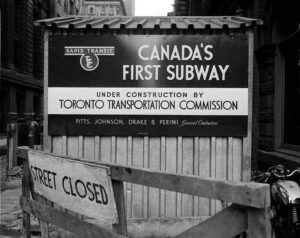
What stands out about that era isn’t just how quickly things were built, but how certain everything felt. Once something was decided, it carried forward with very little hesitation. There wasn’t a sense that a project might stall, shift direction, or stretch indefinitely. It had a beginning, and it had an end, and the space between those two points was filled with visible, steady progress. That same feeling extended along the waterfront as the Gardiner Expressway rose into place, not all at once, but in sections that added to one another until a new edge of the city emerged. It was loud, disruptive, and impossible to ignore — but it moved. You could stand in one spot and come back months later and see exactly how far it had come.
The Gardiner Expressway (1955–1966)
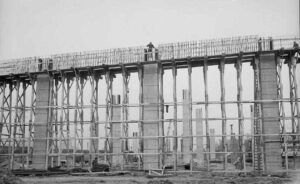
Built in stages over just over a decade, the Gardiner transformed Toronto’s waterfront into a major transportation corridor a project that moved forward with relatively few interruptions once approved.
There was a clarity to it all. The city needed something, it made a decision, and then it followed through. That clarity came from a simpler system fewer layers, fewer competing interests, fewer steps between idea and action and from a different set of expectations. The focus was on building what was needed, not necessarily on examining every possible outcome along the way. That didn’t make it perfect. Neighbourhoods changed quickly, sometimes too quickly, and streets were redrawn without much room for debate. The city moved forward with confidence, but not always with caution. There were consequences to that approach, some of which are still visible today. But there was also momentum, and that momentum shaped how the city felt like it was always moving forward, always becoming something more.
As the decades passed, that feeling began to soften. Not disappear, just change. By the 1970s and 1980s, Toronto had grown into something more complex denser, more layered, with communities that expected to be heard. Building something large no longer belonged only to planners and engineers; it belonged to everyone it would affect. Questions that once might have been overlooked were now part of the process: what does this change, who does it impact, what happens after it’s built? These were necessary questions, but they changed the rhythm. Where the city had once moved forward quickly, it now paused, considered, and often revisited decisions before moving ahead.
St. Lawrence Neighbourhood (1970s–1980s)
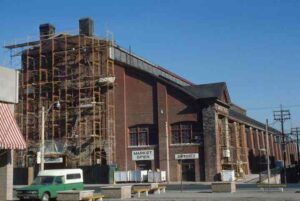
Redeveloped with a stronger focus on planning, community input, and mixed-use design, the St. Lawrence neighbourhood reflected a shift toward more deliberate, people-focused building.
From that point on, building in Toronto took on a different shape. Projects no longer moved in straight lines; they unfolded in stages. Plans were drafted, studied, revised. Conversations stretched. New voices entered the process. What might once have been a decision became a sequence of steps, each one adding something important but also adding time. And time, more than anything else, began to reshape how building worked in the city.
Because time doesn’t just delay a project. It changes it.
Costs rise. Materials fluctuate. Labour becomes more expensive. Contracts evolve. What began as a straightforward plan becomes something heavier, something more difficult to manage. The longer a project exists before it’s built, the more it becomes exposed to change.
And over time, that exposure creates friction.
By the 1990s and early 2000s, that friction had become part of the system itself. Building hadn’t stopped far from it but it had become surrounded by layers that didn’t exist before. Planning, coordination, consultation, revision. Each step made the outcome more considered, but also more distant. A project that once might have taken a few years from idea to completion could now spend that long just preparing to begin.
At the same time, the city itself had become harder to build within. There was less open space, more infrastructure already in place, more systems to work around instead of through. Building something new meant negotiating with everything that already existed physically, politically, and socially.
And that’s where the question starts to creep in.
What changed?
Is it just complexity the natural result of a bigger, more mature city? Or is it something else? Something less visible, but just as important?
Because when timelines stretch and costs rise, people begin to look for reasons.
Sometimes those reasons are structural. A system with more checks and balances will always move more slowly. A city that listens to more voices will take longer to decide. A process that tries to avoid mistakes will naturally hesitate more before acting.
But sometimes the perception goes further than that.
When projects stall, when budgets grow, when timelines shift again and again, it becomes harder to tell where complexity ends and inefficiency begins. Layers that were meant to protect the process can start to obscure it. Decisions become harder to trace. Accountability becomes harder to see.
And in that space, something else takes hold.
Not always corruption in the obvious sense not necessarily backroom deals or clear wrongdoing but a system that feels harder to understand, harder to trust, and harder to follow from start to finish. A system where so many parts are moving that no single part feels fully responsible.
That’s where the contrast becomes most noticeable.
There was a time when you could walk past a construction site and understand exactly what was happening you could see the progress, measure it, feel it taking shape in real time. Today, much of that work happens out of sight, long before construction begins. It happens in plans, in studies, in discussions that stretch across years. By the time something physical appears, it has already been in motion for a long time just not in a way most people can see.
The work is still being done.
But it doesn’t always feel like movement.
And that’s where the nostalgia lingers.
Not just for speed, or cost, or even simplicity but for something more immediate. A time when the city felt like it was being built in real time, when progress didn’t need explanation, when a decision led, fairly quickly, to something you could see and use. When the system, whatever its flaws, felt understandable.
Toronto didn’t lose the ability to build.
It built a system around building one that reflects everything it has become: more careful, more aware, more complex. But in doing so, it also created a process that can feel distant, layered, and at times, difficult to trust.
It wasn’t always cleaner.
It wasn’t always fair.
But it was simpler — and you could see it working.
0 Comments
be respectfulNo comments yet. Start the discussion.