
Laneway Housing in Toronto
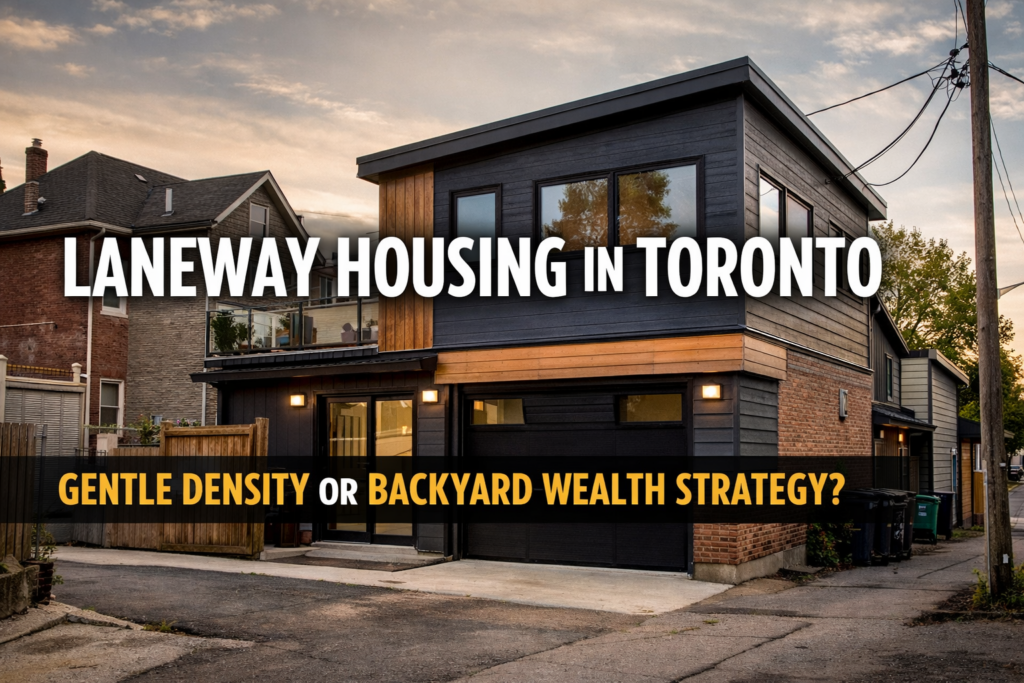
Gentle Density — Or Just Backyard Economics?
There was a time when adding housing in Toronto meant one thing: build higher.
Glass towers defined ambition. Cranes meant progress. If the skyline was moving, the city was growing.
Then the strategy shifted.
Instead of looking up, Toronto started looking behind the house.
Laneway suites came first — small, detached homes built at the rear of properties backing onto public lanes. Then in 2022, City Council expanded permissions to include garden suites, allowing backyard homes even without laneway access.
The pitch was careful and deliberate. Gentle density. Missing middle housing. More supply without high-rise battles.
It sounded reasonable.
It still does.
But reasonable and transformative are not the same thing.
Toronto legalized backyard housing as part of its response to the affordability crisis. For years, planners argued that too much of the city was locked into single-family zoning while prices climbed and growth continued. The solution, at least in part, was to unlock space that already existed.
A small home here.
A rental unit there.
An incremental increase across thousands of lots.
It was never meant to replace towers. It was meant to soften the edges of scarcity.
And in that narrow sense, it works.
Laneway and garden suites are being built. Families are using them for aging parents. Some homeowners are renting them out. Others are housing adult children priced out of the market.
The concept is not fictional.
But scale matters.
Toronto adds tens of thousands of people every year. Backyard homes add units — but not at a pace that resets the math. The housing crisis was not built in a backyard. It will not be solved in one.
The deeper question isn’t whether laneway housing adds supply.
It’s who benefits most from the policy.
To build one, you have to already own property. In Toronto, that’s the dividing line.
Homeownership here is not just shelter. It’s leverage. It’s equity. It’s financial insulation in volatile times.
A laneway or garden suite can turn a single property into a small income stream. It can offset mortgage pressure. It can boost resale value. It can convert a backyard into an asset.
There is nothing illegal about that. Nothing improper.
But it does shape who the policy serves first.
Renters don’t get to build one.
They can only rent one — often at market rates, because construction costs aren’t small and financing isn’t cheap.
That’s not a flaw in logic. It’s just reality.
There is also the affordability narrative.
Backyard housing is often discussed as part of the housing solution. But these units are not automatically affordable housing. They aren’t price-capped. They aren’t income-tested. They aren’t mandated to rent below market unless an owner voluntarily enters an incentive pathway.
In a city where construction costs have climbed and interest rates have shifted dramatically since 2022, most homeowners who build will price accordingly.
That doesn’t make them villains.
It just means the market remains the market.
Adding supply does not automatically mean lowering rents. Especially when that supply comes at a cost.
Then there’s geography.
Not every lot qualifies. Not every neighbourhood has laneway access. Fire regulations, servicing constraints, setbacks, and building code requirements limit where backyard homes can exist.
Some streets are suddenly viable.
Others will never be.
Opportunity clusters. So do benefits.
On paper, the policy is citywide.
On the ground, it’s selective.
None of this makes laneway housing a failure.
It makes it what it is — incremental.
Toronto didn’t choose backyard density because it was radical. It chose it because it was politically possible. It threads a needle: adding housing without triggering the political resistance towers often invite.
It’s evolution, not revolution.
The backyard gets busier. The skyline keeps rising. The housing crisis continues.
There’s an honesty required in how we talk about policy.
Laneway housing adds units. That’s true.
It gives homeowners flexibility. That’s also true.
But it does not fundamentally change land economics in Toronto. It does not level ownership disparities. It does not reset affordability.
It operates within the system.
And policies that operate within the system tend to reinforce its structure more than they disrupt it.
The cranes are still downtown.
The backyards are getting quieter densification.
The gap between those who own and those who rent remains.
Reader Submissions
Have you built a laneway or garden suite in Toronto?
Did the numbers work out the way you expected?
Was the permitting process smooth — or a maze?
Are you renting one?
Living next to one?
Watching a project stall mid-permit?
WTFTO would like to hear your experience. Submissions can be made confidentially through our Submit a Story page.
1 Comments
be respectfulLeave a comment
More Stories
i would to like to more on this subject….