
Luxury Towers, Empty Units
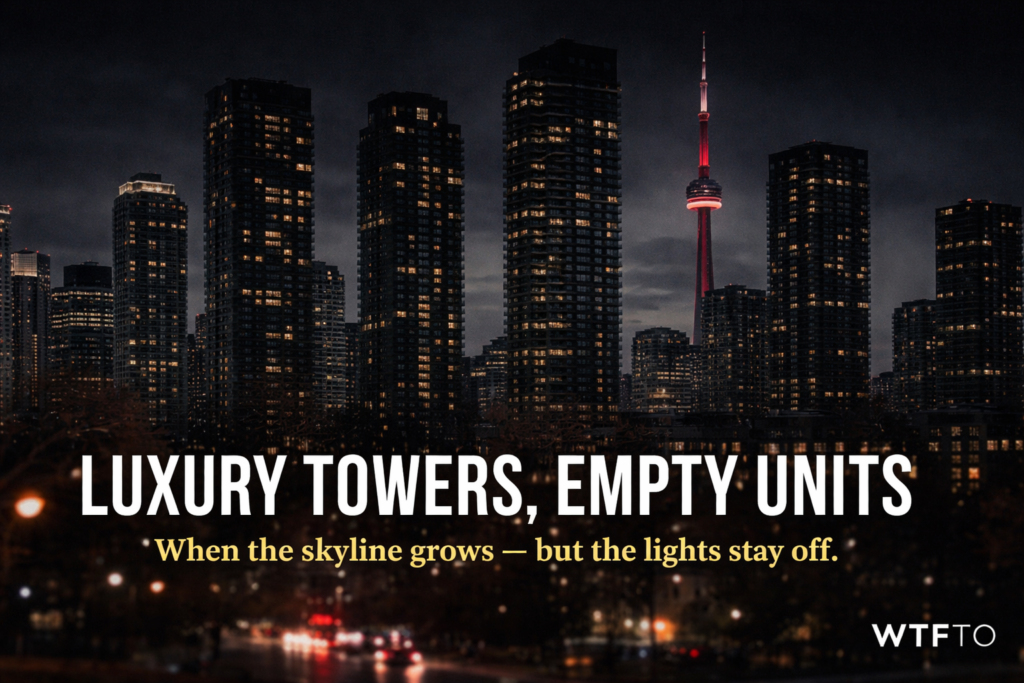
When glass goes up — but nobody moves in.
Editor’s Note: This article examines visible occupancy patterns in recently completed condominium towers across Toronto. It does not allege wrongdoing. Real estate markets are cyclical and complex. However, in a city facing sustained housing pressure, visible vacancy raises reasonable public-interest questions.
By RBT
There’s a moment in Toronto just after 10 p.m.
Patios are still active. Streetcars grind east and west. Traffic slides through Midtown beneath condo canopies lit in soft white LED. The skyline looks prosperous — confident, vertical, expensive.
And then you look up.
Forty, sometimes fifty storeys of newly completed glass rise into the night. Only scattered windows are illuminated.
The crane is gone. The sales centre has closed. The marketing banners that once promised “Elevated Living” now hang quietly above polished lobby entrances. On paper, these buildings are complete.
From the street, many appear only partially alive.
Some residents call it the “night test.” Walk past a recently finished luxury tower at 9:30 or 10 p.m. and count the lit windows. It is not scientific. It does not prove vacancy. Lights off do not equal empty units. Owners travel. Tenants work late. Curtains close.
But when entire vertical stacks remain dark months after occupancy dates, the optics become difficult to ignore — particularly in a city where renters compete for showings and affordability dominates council chambers.
According to the Canada Mortgage and Housing Corporation (CMHC), the Toronto Census Metropolitan Area recorded more than 30,000 condominium completions annually in peak recent years. Supply, at least structurally, has not stalled.
Yet purpose-built rental vacancy has hovered near or below 2% in recent reports. Average condo rents in central areas exceed $2,500 per month for one-bedroom units. First-time buyers continue to describe entry costs that feel increasingly unreachable.
Toronto is building at scale. Many residents still feel locked out.
The Investor Equation
To understand the night test, you have to understand how Toronto’s condominium market functions.
Pre-construction units are typically sold years before completion. A significant share of buyers intend to rent their units. Others assign contracts before closing. Some hold as long-term investments. This structure is legal, common, and deeply embedded in the city’s development model.
Estimates suggest investor ownership in Toronto’s condominium market may range between 35–45%, depending on submarket and building type.
Buildings with high investor concentration often transition more slowly into fully occupied communities. Units can sit between tenants. Assignments can stall when resale conditions soften. Owners may wait for stronger rental markets. Completion does not always translate into immediate habitation.
Dr. Murtaza Haider, a housing researcher and professor at Toronto Metropolitan University, has noted in previous interviews that investor-driven markets can create “a lag between supply delivery and effective occupancy,” particularly during periods of rising interest rates and economic uncertainty.
That lag is not illegal. It is not necessarily improper.
But it is visible.
Capital in the Skyline
Toronto’s vertical growth is not simply a response to population demand. It is also a response to capital.
Consider The One at Yonge and Bloor, marketed as one of Canada’s tallest residential developments. The project entered creditor protection in 2023 before restructuring under new financing oversight. Construction later resumed. There is no allegation of wrongdoing.
Still, its trajectory illustrates a larger truth: Toronto’s skyline is tightly connected to global capital flows, borrowing costs, and investor confidence.
When interest rates rose sharply beginning in 2022, pre-construction absorption slowed. Assignment listings increased. Financing conditions tightened.
A tower can be sold out on paper and still feel hollow at night.
Optics vs. Access
Stand beneath one of these buildings and look up.
The glass reflects traffic signals and office lights. The city hums behind it. But floor after floor remains dark.
This is not proof of vacancy. It is not evidence of misconduct.
It is a contradiction.
Toronto does not appear short on construction. It appears short on accessible homes.
The skyline communicates abundance. The rental listings communicate scarcity.
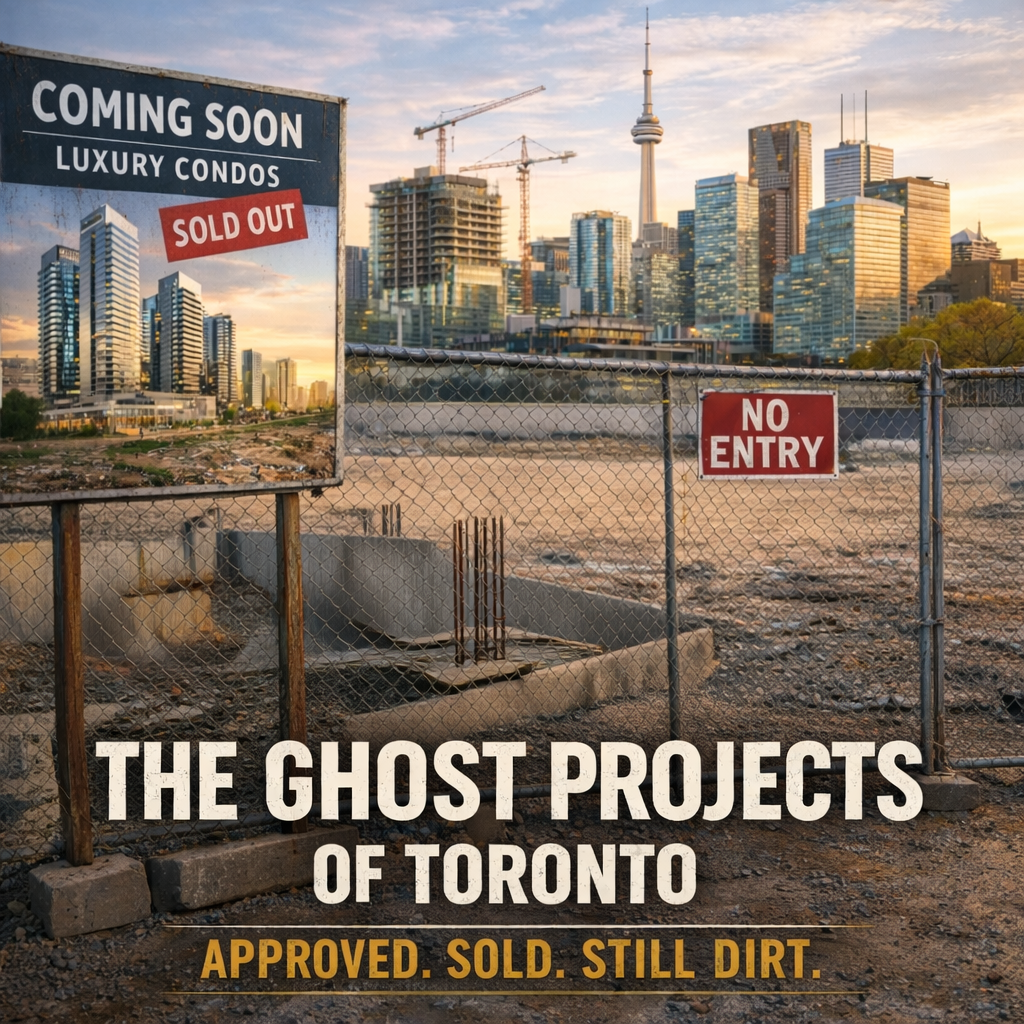
That tension echoes themes explored in Ghost Projects of Toronto, where announcements and approvals did not always translate into lived outcomes. In this case, the cranes are gone. The concrete has cured. The elevators run.
The question has simply moved upward — into the windows.
Homes or Instruments?
Housing policy debates in Toronto revolve around zoning reform, density targets, transit integration, and approval timelines. These are critical discussions. But another question sits quietly above them:
Are we building homes — or financial instruments?
A condominium unit can function as shelter. It can also function as an asset class. In many cases, it functions as both.
When investor participation accelerates development, supply rises. When market conditions shift, timelines stretch. The result can be a skyline that looks complete but feels transitional.
Luxury towers continue to climb. Glass stretches higher each year. The silhouette of the city grows sharper, more dramatic, more expensive.
And yet, night after night, balconies remain unlit.
Below them, renters refresh listings that have not become cheaper. Buyers rework budgets that no longer stretch as far. Policymakers cite completion statistics. Developers cite pipeline numbers.
The skyline suggests progress.
The street suggests pressure.
A City Suspended
Between those two realities lies the quietest part of the story.
A building can be structurally finished and socially unfinished.
A market can deliver units and still withhold accessibility.
A skyline can signal prosperity while residents continue to compete for space below it.
Until glass becomes light — and light becomes lived experience — the night test will continue.
Not as accusation.
Not as proof.
But as a question suspended above the sidewalk.
Window by window.
Floor by floor.
Is this growth?
Or simply height?
More Stories

0 Comments
be respectfulBe the first to comment.