
The Parking & Electric Future Investigation — Part 1: The Driveway Lottery
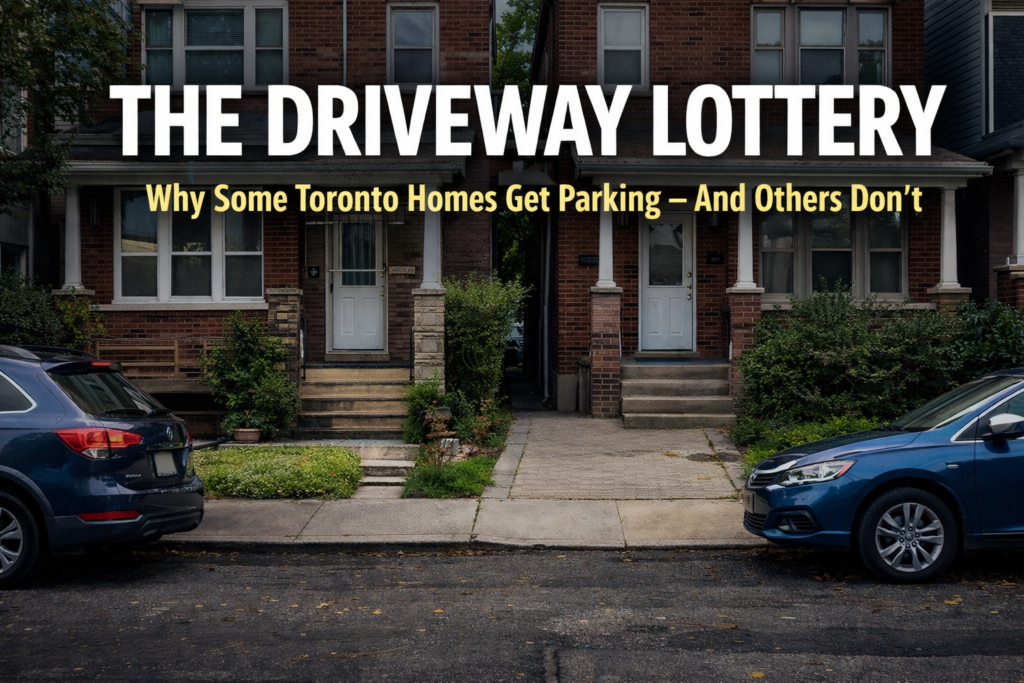
Toronto homeowners share a lot of common frustrations: rising property taxes, endless construction projects, and the daily competition for curb space on residential streets. In many older neighbourhoods, circling the block looking for parking has simply become part of daily life.
But buried inside Toronto’s municipal rule book is a bylaw that determines something surprisingly basic — whether you are even allowed to park a car on your own property.
For thousands of residents across the city, the answer is simple:
You can’t.
Not because the property physically cannot support a parking pad.
Not because there isn’t space.
And not necessarily because it would cause flooding or environmental damage.
In fact, front yard parking already exists legally in many parts of Toronto. The city maintains a registry of licensed residential parking pads, and thousands of homes across the city already use them.
So the issue isn’t whether Toronto allows front yard parking.
It clearly does.
The strange part is how unevenly those rules are applied.
Across the city, two nearly identical houses can face completely different outcomes. One homeowner may be able to apply for a front yard parking pad and receive approval. Another homeowner, living just a few streets away in a nearly identical property, may not even be allowed to apply.
The difference often has little to do with the land itself.
Instead, it depends on something far harder for residents to understand — a complicated patchwork of legacy bylaws, historic planning decisions, and political boundaries that determine where front yard parking is permitted and where it is effectively banned.
In other words, in Toronto, the ability to park in your own front yard can sometimes feel less like planning policy and more like a geographic lottery.
And once you start looking closely at how the rules are applied, the questions become difficult to ignore.
If the environmental concerns are the same across the city, why are the rules so different depending on where you live?
That question sits at the centre of Toronto’s front yard parking debate — and it reveals a deeper contradiction in how the city approaches housing, infrastructure, and land use.
Because while homeowners are often told a small parking pad would damage the landscape, the city is simultaneously approving far larger forms of development on the very same residential lots.
And that’s where the story really begins.
A Patchwork Rule Few People Know About
Front yard parking in Toronto is governed by Municipal Code Chapter 918, a bylaw that determines when — and whether — a homeowner can legally create a parking pad in the front of their property.
On paper, the rule appears straightforward. It outlines requirements for licensing, landscaping, and curb access, and it is framed around environmental protection. City officials argue that limiting front yard parking helps preserve green space, reduce stormwater runoff, protect tree roots, and maintain the traditional character of residential streets.
These are reasonable objectives. Few residents would dispute the importance of protecting Toronto’s urban landscape.
But the reality of how the bylaw operates across the city tells a more complicated story.
Because in practice, not all neighbourhoods are treated the same.
In some areas of Toronto, homeowners can apply for a licensed front yard parking pad through an established process. Thousands of these pads already exist and are legally registered with the city.
Yet in other parts of Toronto — often just a few streets away — homeowners cannot even begin the application process.
The option simply does not exist.
What makes this difference striking is that it often has little to do with environmental conditions. The soil is the same. The rainfall is the same. The trees are the same.
Sometimes even the houses are nearly identical.
Instead, the dividing lines often follow something else entirely: legacy planning boundaries and political decisions made decades ago, when Toronto’s municipal landscape looked very different than it does today.
The result is a system that can feel less like a consistent environmental policy and more like a patchwork, where the ability to create a legal parking pad may depend less on the property itself and more on which side of an invisible line your house happens to fall on.
Where Parking Pads Exist — And Where They Don’t
Toronto’s housing landscape tells a story about when different neighbourhoods were built — and that history plays a major role in how parking works today.
Many of the city’s older neighbourhoods — including areas like Davenport, the Junction, Riverdale, the Danforth, and parts of the Beaches — were developed long before private driveways became a standard feature of residential design.
Houses in these communities were typically built on narrow lots, positioned close to the sidewalk, with mature tree canopies lining the streets and very limited space between homes.
In many cases there were no rear laneways and no provision for private parking at all, because when these neighbourhoods were built, most households simply didn’t own cars.
As a result, street permit parking eventually became the default solution.
For many homes in these areas, it remains the only practical place to leave a vehicle overnight.
What makes the situation particularly frustrating for some residents is that these same neighbourhoods — the ones least likely to have built-in driveways — are often the places where obtaining approval for a legal front yard parking pad is the most difficult.
The communities that rely most heavily on curbside parking are frequently the same ones where the rules surrounding front-yard parking are the most restrictive.
It’s a planning paradox that continues to shape how parking works across large parts of Toronto today.
Two Houses, Two Different Rules
Consider a simple scenario that plays out across Toronto more often than many people realize.
A semi-detached house in Davenport sits on a narrow residential lot built in the 1920s. Like many homes from that era, it was constructed close to the sidewalk, with no rear laneway access and no driveway planned into the original design.
For the homeowner, street permit parking is the only option available.
Now move a few kilometres east to Scarborough, where a house with a very similar lot width sits on a comparable residential street.
The key difference is timing.
The Scarborough home was built decades later, when driveways were already part of suburban planning. As a result, the property already includes off-street parking.
When the homeowner there decides to install an electric vehicle charger, the process is relatively straightforward — typically involving little more than electrical work and the necessary permits.
Meanwhile, the homeowner in Davenport faces a very different situation.
In many cases, they cannot even begin the process of applying for a front-yard parking pad — regardless of whether the space could be engineered responsibly.
Two houses.
Two neighbourhoods.
Two completely different sets of rules.
The Environmental Argument
City officials often justify restrictions on front yard parking by pointing to environmental concerns.
The arguments usually focus on familiar planning principles: limiting stormwater runoff, preserving permeable soil, protecting tree roots, and maintaining the character of residential streets.
These concerns are legitimate.
Toronto’s urban tree canopy is a critical environmental asset that helps reduce heat, improve air quality, and manage stormwater.
At the same time, the city’s aging drainage infrastructure already faces pressure during heavy rainfall events.
But the argument becomes more complicated when viewed alongside other forms of development the city actively permits.
In recent years, Toronto has aggressively promoted new housing density through laneway suites, garden suites, multiplex conversions, and mid-rise developments.
These projects often involve permanent structures with foundations, utilities, and significant building footprints — replacing soil with concrete and roofing.
Entire laneway homes are now being built in spaces that were once open backyards.
Large residential developments routinely replace multiple properties with far greater amounts of hard surface area than a modest parking pad would ever create.
This contrast is what many homeowners find difficult to reconcile.
A small parking pad — particularly one built with modern permeable paving — may occupy only a fraction of the space covered by a laneway suite or new residential structure.
Yet the parking pad is often treated as the greater environmental concern.
The Laneway Suite Paradox
Toronto has made it clear that increasing housing density is a priority.
City planning policies now actively support laneway suites, garden suites, and other forms of infill housing designed to increase the number of homes within existing neighbourhoods.
Many of these projects involve constructing permanent buildings in rear yards or laneways — structures requiring foundations, plumbing, electrical systems, and extensive building footprints.
In practical terms, these developments introduce far more permanent structural impact than a modest front yard parking pad.
From a housing policy perspective, the reasoning is understandable.
Toronto needs more homes.
But the comparison still raises an uncomfortable contradiction.
If the city is willing to approve entirely new residential buildings on the same lots — structures that inevitably increase lot coverage and drainage demands — why is a small engineered parking pad so often treated as the greater environmental concern?
Especially when modern parking pads can be built using permeable paving systems specifically designed to manage stormwater runoff.
For some residents, the question becomes unavoidable:
Are environmental concerns always being applied consistently — or are different types of development simply judged by different standards?
The Politics of the Curb
Urban planning decisions are rarely based on technical considerations alone.
They are also shaped by politics, public pressure, and the priorities of local representatives.
Over the years, different Toronto councillors have taken very different positions on front yard parking within their wards.
In some neighbourhoods, regulated parking pads have been accepted as a practical solution to narrow streets and limited parking supply.
In others, councillors and community groups have strongly opposed them, arguing they threaten neighbourhood character or reduce green space.
The result is a regulatory landscape that often looks less like a consistent citywide policy and more like a patchwork of local compromises.
Two wards with nearly identical housing patterns, lot sizes, and tree coverage can end up operating under completely different expectations when it comes to front yard parking.
When the environmental conditions and neighbourhood designs are often similar, the uneven outcomes naturally lead residents to ask a simple question:
If the rules are based on environmental concerns, why do they produce such different results depending on where you live?
The Driveway Lottery
Across Toronto, the city maintains a registry of licensed front yard parking pads.
So the issue isn’t whether front yard parking exists.
It clearly does.
The real debate is about how unevenly access to those permissions is distributed.
For many homeowners, the ability to create a legal parking pad can feel less like a consistent planning process and more like a lottery.
One resident may be able to apply for and install a front yard parking space with the city’s approval.
Another homeowner — living just a few blocks away in a nearly identical house — may not even be allowed to begin the process.
Often the difference has little to do with the property itself.
Instead it comes down to geography, legacy planning rules, and the political history of a particular neighbourhood.
The Question Toronto Hasn’t Answered
Front yard parking debates have existed in Toronto for decades.
For much of that time, the arguments revolved around aesthetics, neighbourhood character, and the preservation of green space.
But the conversation is beginning to shift.
Because the issue is no longer just about where a car sits overnight.
It now intersects with something much bigger:
Infrastructure.
Energy policy.
And the future of transportation in a city that is actively pushing toward electrification.
Toronto has declared a climate emergency.
It promotes electric vehicles as part of its long-term emissions strategy.
Yet the same city maintains a patchwork of rules that determine whether residents can even create the off-street space needed to support that transition.
In neighbourhoods where driveways already exist, the shift to electric vehicles may be simple.
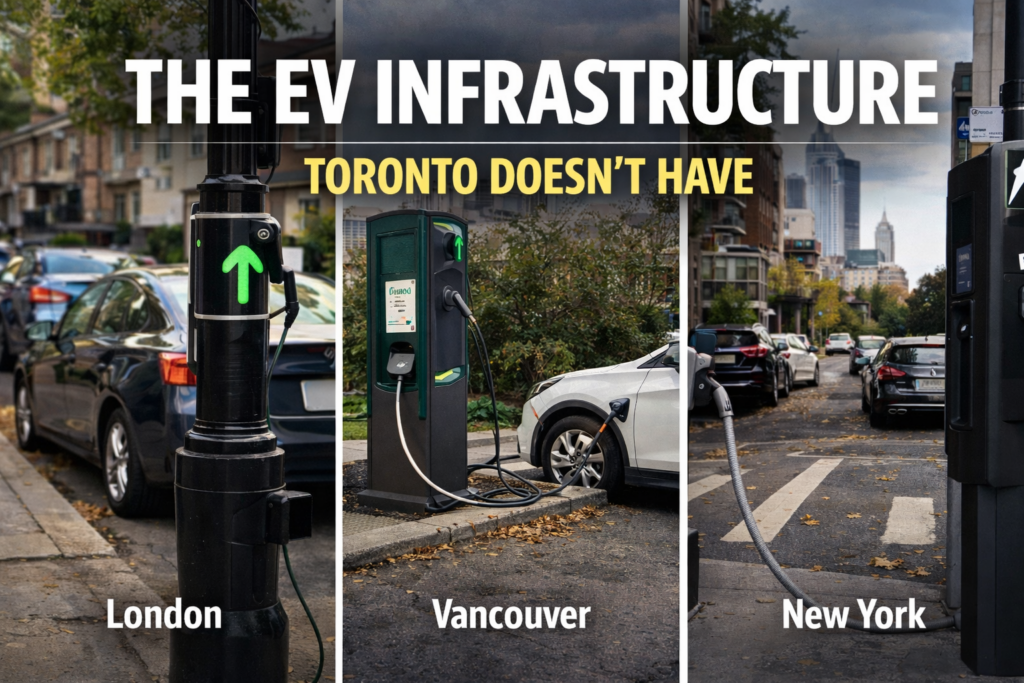
But in many of Toronto’s older communities, residents face a very different reality — a future where the city encourages electric cars while its own bylaws make charging them at home nearly impossible.
Which leads to a question Toronto has not fully answered yet:
If the city is serious about an electric future, how long can a system remain in place where some homeowners are free to adapt — and others are legally prevented from even trying?
Because once parking policy begins shaping the rules of energy and transportation, the debate is no longer just about curb space.
It’s about who gets to participate in the city’s future — and who gets left parked on the street.
More Stories
0 Comments
be respectfulBe the first to comment.