
Toronto spent billions on Finch West LRT. So why did it need a speed fix after opening?
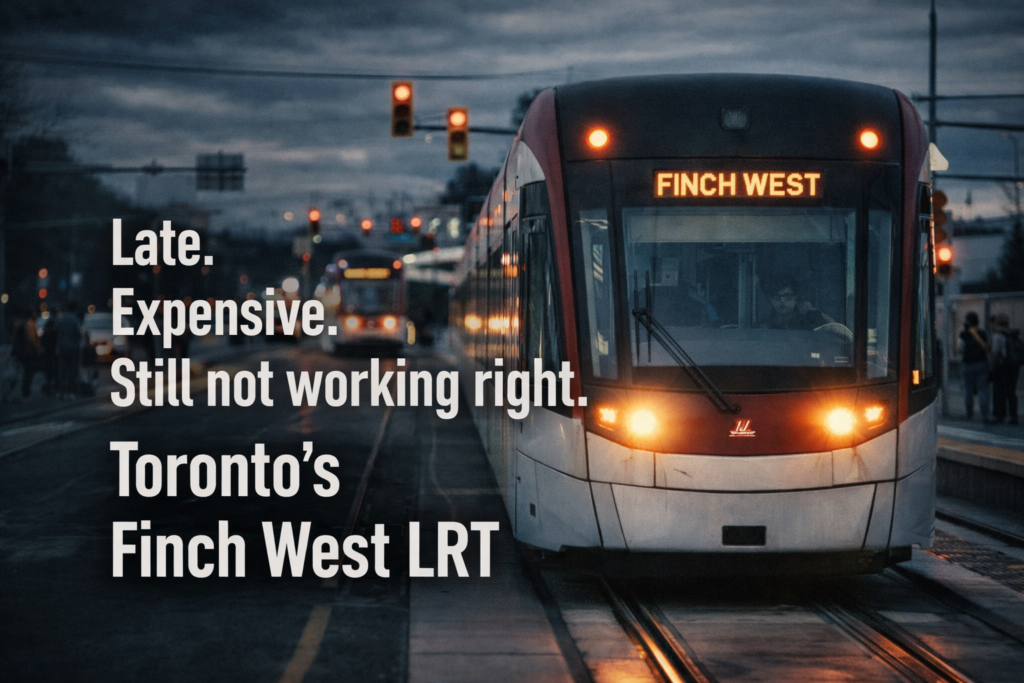
The Finch West LRT was supposed to be a long-overdue rapid-transit upgrade for northwest Toronto. After years of construction, delays, disruption, and political self-congratulation, Line 6 finally opened and riders were told the wait was over.
But almost immediately, the line ran into a problem that cut straight to the heart of the project:
For something sold as rapid transit, it did not feel especially rapid.
That is not some minor technical complaint. It is the whole point.
If a city spends billions on a new transit line, makes the public wait years for it, then opens it only to start publicly improving the traffic-light treatment afterward, people are entitled to ask a very simple question:
Why wasn’t that sorted out before day one?
Line 6 Finch West officially opened to riders on December 7, 2025. The province said the project achieved substantial completion on November 12, 2025. The line runs roughly 11 kilometres with 18 stops, connecting Finch West Station to Humber College and linking into a broader regional transit network.
On paper, this was supposed to be a major upgrade for a part of Toronto that has waited a long time for better transit.
Instead, within days of opening, the conversation turned to trip times.
CityNews reported that the TTC’s opening-day schedule was built around a 46-minute end-to-end travel time. That immediately clashed with earlier public-facing expectations of about 33 to 34 minutes from end to end. That is not a small gap. That is the difference between a line people experience as rapid transit and a line people start questioning right away.
And this is where the story gets hard to ignore.
On March 11, 2026, the TTC announced that the first stage of enhanced transit signal priority was now in place on Line 6 Finch West. The City changed traffic signals so LRT vehicles could move through intersections before left-turning vehicles, and more dynamic, real-time changes were still scheduled to roll out afterward. CityNews reported riders may not feel the full benefit until the end of May 2026.
That is welcome news for riders.
It is also a quiet admission.
Because if those changes are important enough to improve trip times now, then they were important enough to have in place before the line opened.
That is the part nobody should blur.
This is not just a transit story. It is an accountability story. Toronto keeps doing this with major projects: the public gets years of disruption, patience lectures, missed dates, and polished announcements - and then, once the thing finally opens, everyone is asked to accept that a few important details will be handled later.
No.
A rapid-transit line is not a beta test. You do not open it, let riders discover what is wrong, and then begin rolling out the fixes that make it behave more like the product people were promised in the first place.
If traffic signals were always going to be a major factor in whether Finch West felt fast, then those signals were not some side issue. They were central to the line’s performance. And if the TTC is now saying signal-priority changes will improve service, then it is effectively acknowledging that the opening version was not good enough.
That is why this story resonates beyond transit-watchers.
Most people do not care about procurement jargon, operating agreements, or inter-agency buck-passing. They care about whether the thing works. They understand one simple idea: if you spend billions on rapid transit, it should be rapid.
Not eventually rapid. Not rapid after a few phases of post-launch adjustments. Not rapid once the city gets around to fixing the intersections. Rapid.
There is now a second layer to the story, too.
Public reporting has raised questions about Toronto turning to U.S. technology tied to the signal work while Ontario firm Miovision says it was shut out. That angle deserves attention, but it also deserves care. Based on what is publicly verifiable right now, it is fair to say the issue has been raised publicly. It is not fair to toss in an exact contract value unless the procurement documents are in hand.
Still, even without that piece fully nailed down, the political problem is obvious. Toronto opened a supposedly rapid line without fully solving a speed issue tied to traffic signals, then had to go back and improve the setup afterward.
That is not a clean transit success story. That is a city still trying to finish the job after telling the public the job was done.
To be fair, the TTC and City are now trying to improve things. Good. They should. Riders on Finch West deserve faster and more reliable service, not excuses. And if signal-priority changes make a real difference over the next several weeks, that is a win for the people who actually use the line.
But those improvements do not erase the bigger question.
They sharpen it.
Because the real issue is not whether Finch West can be made better now.
It is why a line sold as rapid transit appears to have opened before one of the key ingredients of that promise was fully in place.
Toronto did not just open Finch West late.
It opened it before it had fully solved the problem of making it feel fast.
And for a city that is always talking about building the future, that is one hell of an old mistake.
6 Comments
be respectful
Leave a comment
More Stories
Remember that this is not a line that TTC designed or built. TTC is operating what it has been given. TTC has been advocating for more aggressive signal priority for its vehicles for years, to little avail because there is such a fear in this city about doing anything that might possibly affect car traffic. The Finch West LRT with signal priority would never have been approved in the first place because it would have been blamed for slowing down traffic, regardless of whether that’s true or by how much. We would then have either not built anything, or we would have spent an extra decade and billions $ more putting the line underground for little overall benefit. It is only now, after the fact, that signal priority is being recognized as a real solution to make transit work better. Better late than never in this city.
Fair point. TTC is operating what it was handed, not necessarily what it would have ideally designed. But that actually reinforces the broader criticism: Toronto keeps building transit in compromised form because of political fear over car traffic, then wonders why the results fall short. If signal priority was always a known solution, the real failure was not implementing it from the start. Residents are tired of projects that arrive late, cost plenty, and still come with avoidable limitations.
You are correct. But ever since Rob Ford won the mayoralty with his “subways subways subways” dogma, there has been a concerted public backlash against anything that gets in the way of cars, or is perceived to do so. The fact that continuing to grow car use at past rates is not sustainable, and that there is no physical capacity to expand the road network is ignored by those who think that removing bike lanes, transit lanes or just co-ordinating traffic signals will “solve” congestion and magically take us back to 1980. There is also the unsustainable assertion that all transit must be underground regardless of the cost. It’s a foolish and ultimately useless idea when applied to the full network context, but it’s the prevailing one these days. I’m hoping there is enough momentum now behind real signal priority to show how it can improve surface transit, along with more reserved lanes.
In a seasonal country with heavy snow, underground transit simply makes more sense for a city like Toronto. If more of the network is kept above ground, it creates even more competition for limited street space — less room for road expansion, less flexibility for bike lane expansion, and more conflict with traffic, turning vehicles, and gridlock. Surface transit can work in some places, but in a dense city already struggling with congestion, pushing too much onto the roads only adds pressure to a system that is already overloaded.
That is why many people continue to support underground transit. It is not just about convenience — it is about reliability, climate, and long-term city planning. In a place like Toronto, winter alone is a strong argument, but so is the simple fact that the streets above are already fighting over every inch of space.
There are corridors where underground makes sense, but they aren’t the majority. Spending tens of billions of $ for underground transit should not ignore the primary role of transit, which is to carry riders. Transit’s main objective isn’t to avoid winter, nor is it to ensure that cars will never be impeded on the roads. The ridership potential and associated capacity requirements should be the primary factors that drive the decision on which transit mode to use for any proposed service, whether it is bus, LRT or subway. If you locate a subway where ridership potential is low, it doesn’t matter how cold the winter or how reliable the service, it will not be cost effective if those expensive trains are only carrying a handful of people. The belief that winter and not using up road space should determine transit decisions is ideological, not fact-based. There are no data that show that transit ridership is dependent on the seasons or on how much road space is or is not used. Quality of service *is* the determining factor, but it isn’t dependent on being underground. It is possible for surface transit to be reliable and convenient if it is properly designed and operated, and at considerably less capital and operating cost than going underground. Transit planning cannot pretend that money is no object because that isn’t reality — like most public services, it must find the balance between providing as much service as possible, and ensuring cost effectiveness.
Decreeing that all new transit lines should be underground will simply guarantee that no new transit lines will be built for a long time. That’s how we got into this mess in the first place after the Let’s Move subway expansion of the 1990’s was cancelled due to spending cutbacks. It also doesn’t help that the Ontario Line, now under construction, is a colossal waste of money, delivering light metro capacity for all the costs of a full subway. It’s a line where the originally-proposed full-capacity subway was actually ridership justified, yet the government downgraded its capacity with no cost savings. That backroom decision is one of the worst examples of political interference in transit planning since Mike Harris truncated the Sheppard Subway at Don Mills and filled in the hole at Eglinton West Station. The Ontario Line will deliver good service, but it will struggle to deliver the required capacity sooner in its life cycle than it should considering how much it is costing. All transit decisions should be made based on facts, not on pre-conceived ideology.