Toronto’s Newest Talent: Copying New York and Calling It Vision
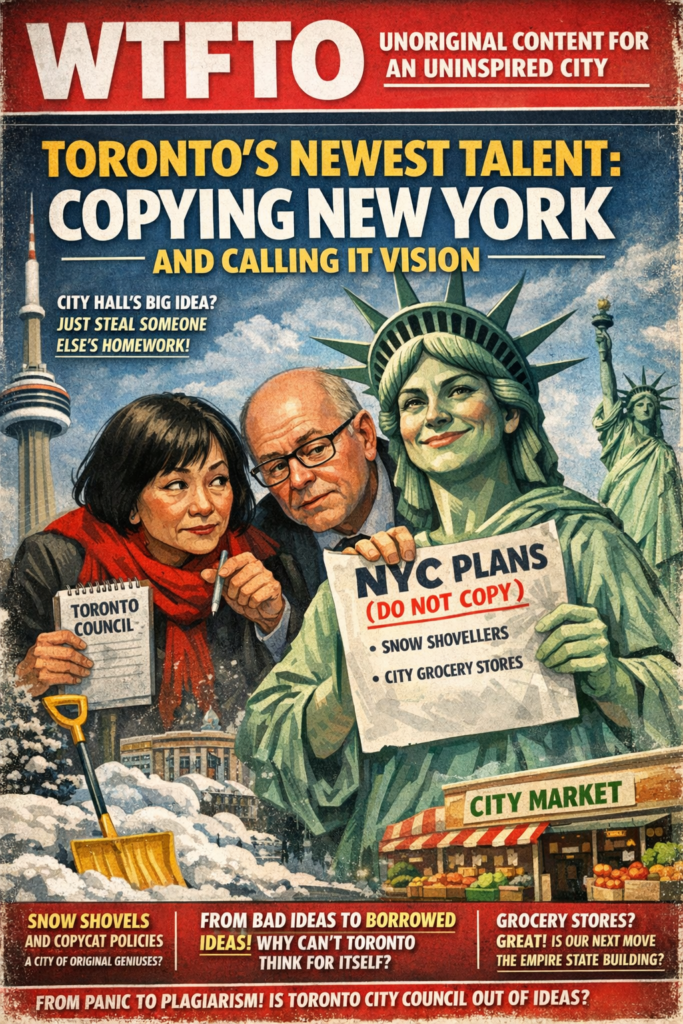
If Toronto City Council ever has an original thought, it should probably report it to 311.
Toronto City Hall has done it again.
Faced with sidewalks buried in snow, groceries eating people alive, and residents increasingly wondering whether this city is being run by adults or just a rotating cast of professionally confused committee addicts, Council has reached deep into its bag of ideas and pulled out something truly familiar: New York’s homework.
Not inspired by.
Not adapted from.
Not thoughtfully reworked for Toronto’s own mess.
Just borrowed, dusted off, and presented to the public like some kind of municipal breakthrough.
First the Sidewalks
After another winter where Toronto managed to act shocked — shocked — that snow falls in Canada, Mayor Olivia Chow formally called for a paid surge-capacity sidewalk shovelling program modeled on New York City’s approach. Her March 3 letter says exactly that: Toronto should develop a program “modelled on the successful approach in New York City” for implementation by the 2026–2027 winter season.
And let’s be fair for one second, just so nobody from City Hall hyperventilates into a media statement: Council did not just vote to dump sidewalk clearing back onto ordinary homeowners citywide. The record actually says that in 2021, Toronto expanded sidewalk snow plowing to all sidewalks, replacing much of the old system where property owners were responsible. The new move is about hiring paid backup shovelers because the City’s own system has struggled during major storms.
So no, this is not quite “congratulations, citizens, here’s your shovel.”
It is somehow more embarrassing.
Because the City failed at a basic winter responsibility, then looked to New York for a rescue script.
New York already has an Emergency Snow Shovelers program through its sanitation department. It hires temporary shovelers to clear public areas like bus stops, crosswalks, fire hydrants, and step streets after major snowfalls. Toronto, after another winter of public frustration, has now decided this is the kind of “innovation” worth importing.
Which raises an uncomfortable question: does Toronto City Council actually generate ideas, or does it just wait until another city posts them online?
Then, Naturally, Groceries
Because apparently one borrowed idea per month is not enough, Council is also now flirting with municipally operated grocery stores.
A March 25 notice of motion from Councillor Anthony Perruzza calls for a pilot project to open four city-run grocery stores, one in each community council district, under a not-for-profit model, potentially supported by waived property taxes, development charges, and other fees. The motion says the City “must explore innovative ways” to improve food access and affordability.
“Innovative” is doing a lot of work there.
Because New York, once again, is already in this conversation. The New York City Comptroller’s March 2026 budget commentary notes that the city’s February capital plan includes a new $70 million for the mayor’s city-run grocery store initiative.
So there it is again.
Toronto freezes, then looks at New York.
Toronto panics, then looks at New York.
Toronto wants to look bold, and once again, somehow, there is New York in the background holding the original notes.
At this point, City Hall should stop pretending these are homegrown ideas and just start every press conference with: “After reviewing another city’s assignment…”
A Council Without an Imagination
Now, cities should absolutely learn from each other. That is normal. That is smart.
But there is a difference between learning and living permanently in someone else’s shadow.
The problem with Toronto’s political class is not that it borrows ideas. The problem is that it so often seems incapable of producing any urgency, creativity, or coherence until another city has already gone first. Then suddenly the borrowed idea arrives here, wrapped in concern, drenched in buzzwords, and sold back to residents as evidence of leadership.
That is not leadership.
That is municipal cosplay.
It is City Hall as tribute band.
All cover songs. No originals.
And the worst part is that Toronto is not even copying from a position of strength. It is copying while visibly struggling with the basics. This is a city that routinely overcomplicates simple service delivery, speaks fluent press release but shaky competence, and acts as though every seasonal problem is an unforeseeable act of God rather than an annual managerial test it keeps failing.
Snow? Crisis.
Food prices? Emergency.
Original thought? Now that would be the real pilot project.
What Toronto Actually Needs
Toronto does not need a council that shops for policies like it is browsing another city’s clearance rack.
It needs a council that can think before it copies.
Plan before it panics.
Lead before it borrows.
Because the issue is not just whether New York had the idea first. The issue is how often Toronto looks like it is waiting for permission to govern from somewhere else.
A city this big should not feel this intellectually dependent. It should not feel like every big “new” idea has already had a better version somewhere else. And it definitely should not keep expecting applause for photocopying policy and stapling a Toronto logo on top.
Toronto Council does not need more borrowed ideas dressed up as local genius. It needs a functioning brain, a little humility, and maybe — just once — a plan that was not lifted from another city’s desk. Until then, this is not innovation. It is plagiarism with bylaws.
More Stories


0 Comments
be respectfulBe the first to comment.