



Toronto Got FIFA. City Hall Acted Like It Caught a Disease.
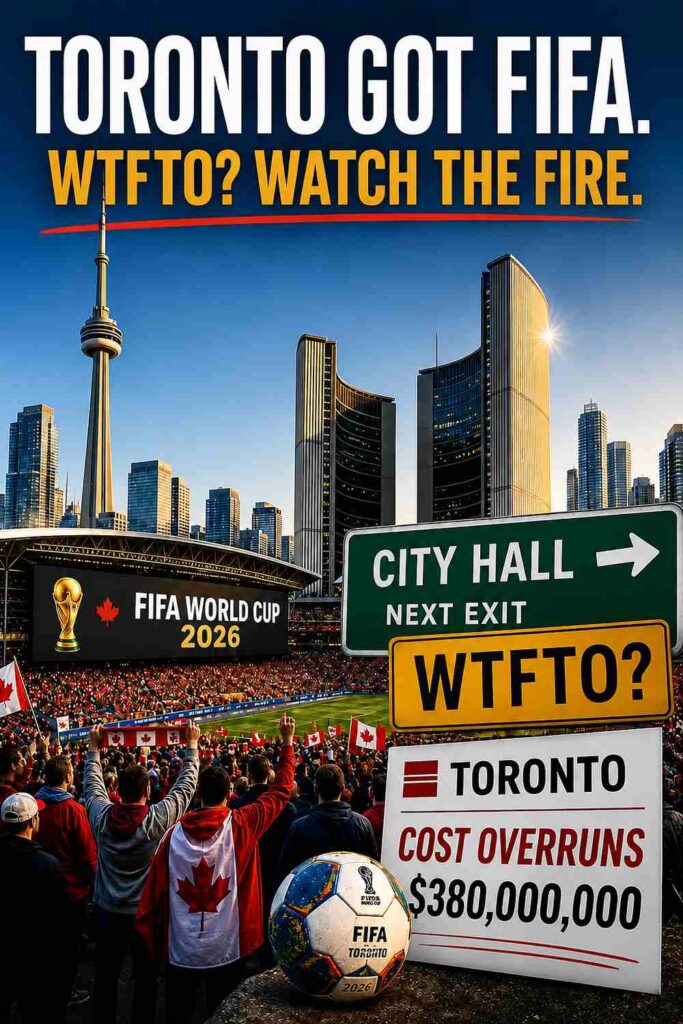
Toronto is about to host one of the biggest sporting events on Earth.
The matches will be packed. The cameras will roll. The city will get a global audience most places would kill for. For a few weeks in 2026, Toronto will be on one of the biggest stages in the world.
That should have been an easy win.
Instead, Toronto did what Toronto always does: took a massive international opportunity and wrapped it in whining, political defensiveness, and a public debate that made it sound like the city had been sentenced to hard labour.
That is the real embarrassment here.
Not FIFA.
Not soccer.
Not even the price tag, as ugly as it is.
The embarrassment is that Toronto landed the World Cup and then spent half the time talking about it like it was a raccoon in the attic.
Toronto wanted the prestige — just not the bill
This did not start with Olivia Chow.
Toronto’s FIFA path began under John Tory. Council backed participation in the North American bid in 2018. In April 2022, Council moved Toronto’s host-city bid forward. On June 16, 2022, FIFA officially named Toronto a host city for the 2026 World Cup. At the time, City Hall treated it like what it was: a major international get.
And it was.
This is the World Cup. Not a trade show. Not a mid-level conference with stale danishes and branded tote bags. The World Cup.
The city was always going to get prestige out of it. The problem was that prestige comes with obligations, and obligations come with invoices, and Toronto’s political class has a long history of loving the ribbon-cutting part of things a lot more than the paying-for-it part. Early estimates put hosting five matches at about $290 million. Later, that number climbed to $380 million.
And that is where the whole thing curdled.
Chow inherited the deal — and then shrank the tone
To be fair, Olivia Chow did inherit this file. She did not negotiate the original deal. She did not create the obligations. She walked into office with the World Cup already on the books and the cost estimate rising.
Fine.
But there is a difference between inheriting a problem and sounding defeated by it.
When FIFA later confirmed Toronto would host six matches instead of five, including the first-ever men’s World Cup match played on Canadian soil, that should have been a huge civic moment. A city like Toronto should know how to stand up straight for that kind of announcement.
Instead, the tone out of City Hall often sounded like: yes, yes, we got the World Cup, but please focus on how upset we are about the bill.
That is not leadership. That is pre-emptive excuse-making.
When Chow said she was “saddled with it” and made clear she would not have signed the deal without better funding commitments, she may have been trying to level with taxpayers. Fair enough. But there is a time to fight over the funding formula, and there is a time to stop sounding like your city is hosting the planet under protest.
You do not get to call yourself a world-class city and then act shocked that world-class events cost money.
FIFA is not the problem. Toronto’s small-ball politics are.

This is where the pro-FIFA argument matters.Because the event itself is not some absurd civic indulgence. It is exactly the kind of thing a city like Toronto should want. Six matches. Canada’s opening men’s match on home soil. Billions in global visibility. Hotels packed. Restaurants busy. Bars full. Vendors selling. Tourists arriving. The city projected across the planet as a real international destination.
That is not nothing.
That is not fluff.
That is not just “optics.”
That is part of what major cities compete for.
Toronto is constantly desperate to be taken seriously on the world stage. Well, this is one of the few moments when the world actually shows up, and somehow City Hall’s instinct was to act like it had stepped in something unpleasant.
That is the problem.
Not that residents have questions.
Not that the budget is big.
Not that people want transparency.
The problem is that Toronto’s leadership too often treated the opportunity itself like an inconvenience.
Yes, the cost is outrageous. That still does not make FIFA the villain.
Toronto’s total hosting budget is now pegged at $380 million. That number hits people in the face because the city is not building a brand-new stadium. It is not unveiling some giant transit legacy project. It is not remaking the skyline. So the obvious public question is: how in hell does six games cost this much?
The answer, unfortunately, is that mega-events burn money in ways nobody finds sexy.
The bill is split between operating and capital costs. That means security, tournament operations, staffing, transport management, emergency readiness, communications, contingency, and all the temporary machinery required to host an event that the whole world is watching. On top of that, there are venue upgrades to BMO Field and related facilities so they meet FIFA standards: accessibility work, dressing rooms, suites, boards, lighting, audiovisual systems, and other tournament-related upgrades.
So no, Toronto is not building a shiny new monument.
It is doing something much less glamorous and much more expensive: paying to make sure the event works.
That is frustrating. It is also reality.
The mistake is pretending that because the bill is ugly, the event itself must therefore be a bad idea. That is classic Toronto logic: if something costs real money, then maybe ambition itself was the problem.
The real failure was how Toronto sold the story
This is where City Hall really fumbled it.
A stronger line would have been simple: this is a huge opportunity for Toronto, we are proud to host it, and we are going to fight like hell to make sure Ottawa and Queen’s Park pay their fair share.
Instead, the city too often sounded like it wanted credit for resenting the event while still keeping the event.
That is not how confident cities behave.
A 2025 city report said $201.3 million of the $380 million was expected to be offset by federal and provincial funding, leaving Toronto on the hook for about $178.6 million. That is still a big local share, and residents have every right to be angry that higher governments did not simply swallow more of the bill. Reporting also showed that some provincial funding was being consumed by related costs like security, transit-linked expenses, and station beautification. That only made the public irritation worse.
But again: that is a political management failure, not proof that hosting FIFA was some kind of original sin.
A mayor with stronger instincts would have used that moment to pressure senior governments publicly while still making Toronto sound proud, prepared, and serious.
Instead, too often, the city’s message sounded like a shrug in a blazer.
Vancouver looked like a host city. Toronto looked like it needed a nap.
No, there is no solid public evidence that Vancouver was formally about to steal Toronto’s matches.
That is not the point.
The point is that when Canada only has two host cities, comparisons are inevitable. Vancouver looked more settled in the role. Toronto often looked like it was still trying to explain why this whole thing was really someone else’s fault.
And that is just brutal for a city of Toronto’s size.
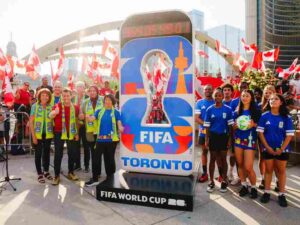
This is supposed to be the country’s biggest city. The economic capital. The place that never stops telling itself it matters. Yet on one of the rare occasions when it actually had a global spotlight handed to it, Toronto’s political tone felt weirdly timid, cranky, and small.
That should bother people.
This is bigger than soccer
The deeper issue here is what this says about how Toronto governs itself.
This city loves status, hates confidence, fears cost, and often mistakes caution for maturity. It wants to be seen as global, but the second global status comes with a giant invoice, everyone starts reaching for the smelling salts.
That is why the FIFA file matters.
Because it exposed something ugly and familiar: Toronto often behaves like a city that wants recognition without risk, prestige without spending, and ambition without discomfort.
That is not how big cities work.
That is not how serious cities work.
And that is definitely not how host cities should sound.
Chow’s defenders can say she was being prudent. Fine. But prudence is not the same thing as leadership, and complaining about the price of admission after the doors are already open is not a vision. It is just a more polished form of municipal panic.
Final word
By the time the first whistle blows, Toronto will be ready. The stadium will look sharp. The crowds will be loud. The city will look exactly like what it is: diverse, energetic, internationally recognizable, and fully capable of hosting something this big.
Which is exactly why City Hall’s handling of the file has been so disappointing.
FIFA was the opportunity.
The whining was the own-goal.
Toronto should have met this moment with swagger, discipline, and a clear message: this city belongs on the world stage, and we are going to show why.
Instead, under Mayor Chow, too much of the public tone sounded like embarrassed bookkeeping.
Toronto got FIFA.
And City Hall responded like it had been handed a parking ticket.
Toronto Backtracks on FIFA Fan Fest Fee After Public Blowback!
https://www.cbc.ca/news/canada/toronto/fifa-fan-fest-ticket-cost-9.7173004
Something I hadn’t thought about. But it makes sense. Instead of whining about what Toronto has been stuck with let’s promote the occasion and justify the expense. Lvj
Toronto should absolutely be promoting the occasion and making the most of it. It’s a massive global event. The frustration is that City Hall didn’t start there. The tone out of the gate was more defensive than confident.