



Toronto’s Parking Cash Grab Is Dressed Up as “Mobility Policy”
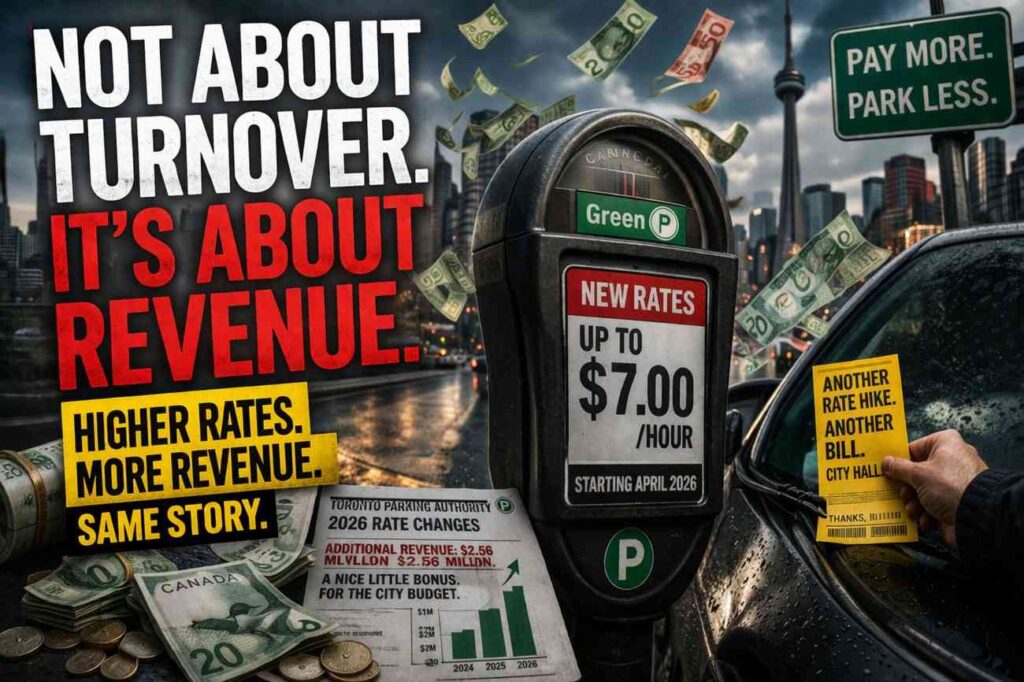
Nearly all of Toronto’s metered street parking is in line for higher rates. City Hall says it’s about turnover, congestion, and smarter curb management. Drivers might call it what it looks like: another well-dressed cash grab from a city that keeps making daily life harder, then acting like it’s doing residents a favour.
Toronto has a talent for making punishment sound progressive.
It never just charges people more. It never just admits that life in this city is becoming a slow, relentless gauntlet of fees, surcharges, workarounds, restrictions, and bureaucratic little insults. No — Toronto prefers to perfume the hit first. It gives the bill a mission statement. It wraps the inconvenience in consultant language. It talks about “mobility,” “optimization,” “financial sustainability,” and “curbside management,” as though residents are supposed to feel grateful while reaching for their wallets.
This time, the target is on-street parking.
The Toronto Parking Authority’s 2026 rate-change report lays it out in calm, clinical language: more than 20,000 on-street parking spaces under management, a broad $0.25 per hour increase across much of the city, and steeper increases in higher-demand zones. The language is bloodless, managerial, sterile. But the lived experience is not. The lived experience is simple: one more thing in Toronto costs more than it did before, and the people paying it are expected to nod along while the city congratulates itself for being smart. The official rationale is turnover, congestion reduction, and alignment with the city’s financial and mobility goals. The unofficial translation is easier to understand: Toronto found another way to squeeze people who still need cars and dressed it up as enlightened urban policy. (Toronto)
If almost every meter goes up, this is not fine-tuning. It is policy by squeeze.
What makes the spin especially irritating is not just that the rates are rising. It is the scale of it.
When a city tweaks a few high-demand areas, that can be argued as targeted management. When nearly the whole meter network gets hit, it stops looking precise and starts looking predatory. The Toronto Parking Authority’s own report says the change is expected to generate an additional $2.56 million in net revenue in 2026, with implementation costs of about $0.5 million. CityNews reported that the increases would affect nearly 93 per cent of all metered parking spots across Toronto. That is not a little calibration. That is a citywide money sweep with a planning memo stapled to it. (Toronto)
And the numbers are not abstract. They translate directly into the everyday friction of living here. The TPA report says current on-street rates range from $1.50 to $6.75 per hour, with some proposed rates rising as high as $7.00 per hour. Some areas jump from $4.25 to $5.50. Others rise from $5.50 to $7.00. The increases land hardest in parts of Toronto where demand is highest — downtown, Yorkville, North York Centre, and the University of Toronto area — places where residents, workers, contractors, visitors, caregivers, delivery drivers, and customers are already being nickeled-and-dimed by every other part of city life. (Toronto)
And that is the part urban policy people often pretend not to understand. Cars are not some weird luxury for the morally compromised. They are not a vice. They are not an ideological confession. For a huge number of people, they are a tool. A necessity. A schedule saver. A caregiving lifeline. A work requirement. A way to move equipment. A way to get an elderly parent somewhere on time. A way to survive a city that still talks big about transit while regularly failing to deliver a system that fits real life, real work, real errands, and real time constraints.
Yet Toronto increasingly treats driving as both essential and contemptible. It still relies on drivers for commerce, trades, deliveries, appointments, pickups, drop-offs, medical trips, family logistics, and plain old economic activity. But it governs them like a problem class — an easy population to charge harder because they are politically convenient to scold.
The city says turnover. Drivers hear toll booth.
To be fair, the city is not hiding its stated reasoning. The Toronto Parking Authority says on-street parking is meant to be short-stay parking, that higher rates improve turnover, and that turnover supports businesses and better use of limited curb space. The report also says City Council requested parking-rate increases on February 10, 2026 to support the city’s financial and mobility goals. Green P’s public notice repeats the same theme: higher rates help keep spaces available, keep Toronto moving, and take effect beginning in April 2026. (Toronto)
Fine. That is the official story.
But official stories in Toronto have a habit of collapsing on contact with reality.
Because in reality, people are not encountering these rate hikes in a vacuum. They are encountering them in a city where rent is brutal, ownership costs are worse, groceries hurt, insurance is obscene, construction is constant, traffic management is inconsistent, road access keeps changing, and simple errands increasingly feel like military planning. People are tired. They are over billed, over managed, and over explained. So when City Hall says, with a straight face, that this broad parking hike is really about turnover, residents are allowed to roll their eyes.
They are especially allowed to roll their eyes when the same documents also talk openly about millions in added revenue.
That is the problem with polished civic language: it always wants the public to focus on the halo and ignore the hand in the pocket. If this were purely about circulation and access, the revenue bump would be incidental. But it is not incidental. It is in the story because it matters. Toronto wants the behavioural effect and the money. It wants the authority to say this is thoughtful policy while still cashing in on the result. Residents are expected to pretend those two things are not connected.
They are connected.
This is not some philosophical debate about parking theory. This is about a city that has learned a very convenient trick: take something ordinary that people depend on, make it scarcer or more frustrating, charge more for it, and then call the outcome “better management.” It is the same spirit that turns basic urban life into a paywall and then acts insulted when anyone notices.
Toronto keeps calling it curb management. Residents keep paying for it.
The TPA report admits the curb is under pressure. Construction, cycling infrastructure, CaféTO, and rapid transit projects have all tightened the squeeze on available parking supply. The report says those pressures contributed to an estimated $2 million revenue loss in 2025. It also says the authority has added more than 900 new on-street spaces in recent years and continues looking for more opportunities. (Toronto)
Read that again and strip away the bureaucracy. Curb space is scarcer. It is more contested. It is more politically loaded. And it is more financially valuable. Which means the temptation to monetize it harder is obvious.
That is where the city’s moral posturing becomes especially tiresome.
Toronto likes to speak as though it is bravely leading residents toward some cleaner, smarter, more efficient future. But too often what that really means is this: less convenience for you, more revenue for us, and a wall of policy language to shame anyone who objects. People are supposed to hear “curb management” and forget that what they actually experience is higher bills. They are supposed to hear “smart mobility” and forget the very dumb fact that a lot of city systems still do not work well enough to replace what the car currently solves.
And then comes the PR varnish. Green P says TPA net income helps support city services, including housing, community safety, transportation, EV charging, and Bike Share Toronto. Fine. Nobody is arguing that public money disappears into a cartoon vault. The point is not that the city spends money on things. The point is that it increasingly funds itself by making normal urban life more irritating and expensive, then framing the burden as virtuous. (Green P Parking)
That is what makes this story larger than parking.
Parking is just the meter where the philosophy becomes visible.
The philosophy is that inconvenience can be sold as discipline. That rising costs can be sold as smart management. That ordinary residents can be shaken down one fee at a time, provided the explanation comes with enough polished civic language and enough talk about “shared goals.” Toronto does not merely charge more. It moralizes the charge. It wants the money and the applause for taking it.
The bigger Toronto pattern: price first, empathy never.
This is the part City Hall never seems to grasp: people do not just react to the amount. They react to the attitude.
And the attitude here is what infuriates. It is the tone of a city that keeps asking more from residents while offering less ease, less grace, and less honesty in return. The attitude says: your hardship is data, your frustration is unfortunate, and your role is to adapt. Pay the higher meter. Accept the new restriction. Reroute again. Budget harder. Be flexible. Be understanding. Be grateful that your punishment has a strategy document attached.
Meanwhile, the same city still depends every day on the very people it loves to lecture. Drivers bring customers to struggling businesses. Tradespeople keep buildings functioning. Delivery vehicles keep commerce moving. Caregivers shuttle relatives. Parents juggle impossible schedules. Workers cross neighbourhoods and job sites on timelines that do not bend around idealistic transit talking points. Toronto has not transcended the need for the car. It has just grown more self-righteous about billing the people who use one.
That is why this parking story works as more than a rates story. It is a miniature of how the city increasingly governs: not by making life easier, but by making alternatives less practical, necessities more expensive, and objections easier to dismiss. The message is always the same. Adjust. Absorb it. Pay more. Call it progress.
Nobody serious is arguing that curb space should be unmanaged. Streets are crowded. Turnover matters. Not every driver deserves a cheap guaranteed spot forever outside every destination. That is not the point.
The point is honesty.
If Toronto wants to say openly that it is using parking as a revenue tool, say that. If it wants to say it is deliberately making driving more expensive in high-demand areas, say that. If it wants to argue that this is the price of the kind of city it wants to build, then make the case plainly and let residents respond like adults.
But spare everyone the soft-focus fiction that a nearly citywide meter hike is just neutral, enlightened housekeeping.
It is a cash grab with a planning glossary.
It is a price increase wearing a halo.
It is the city reaching deeper into the same pockets it always reaches for, then acting offended when people call it what it is.
In Toronto, even standing still now comes with surge pricing.
The meter is not just measuring time anymore. It is measuring how much more the city thinks it can get away with charging.
Toronto can call it mobility policy all it wants. Drivers will still recognize a shake-down when they see one.
At some point, “smart policy” just becomes the city’s favourite synonym for “pay more.”
 Kit
Kit  Bertie
  Shirleen
  Malcolm
  Jerrell
  Petra
Petra
Great work! That is the kind of info that
are supposed to be shared around the net. Disgrace on the seek engines for now not positioning this submit higher!
Come on over and seek advice from my site .
Thank you =)
When someone writes an paragraph he/she retains the idea of a user in his/her brain that how a user can be aware of it.
Thus that’s why this post is outstdanding. Thanks!
I’ll immediately seize your rss as I can not in finding your e-mail subscription hyperlink
or e-newsletter service. Do you’ve any? Please allow me
know so that I may just subscribe. Thanks.
I found this piece to be very engaging and highly informative.
This website is a primary resource for useful information.
I don’t even know how I ended up here, but I thought this post was great.
I don’t know who you are but certainly you’re
going to a famous blogger if you are not already 😉 Cheers!