



Everyone’s a Suspect Until Proven Neighbourly
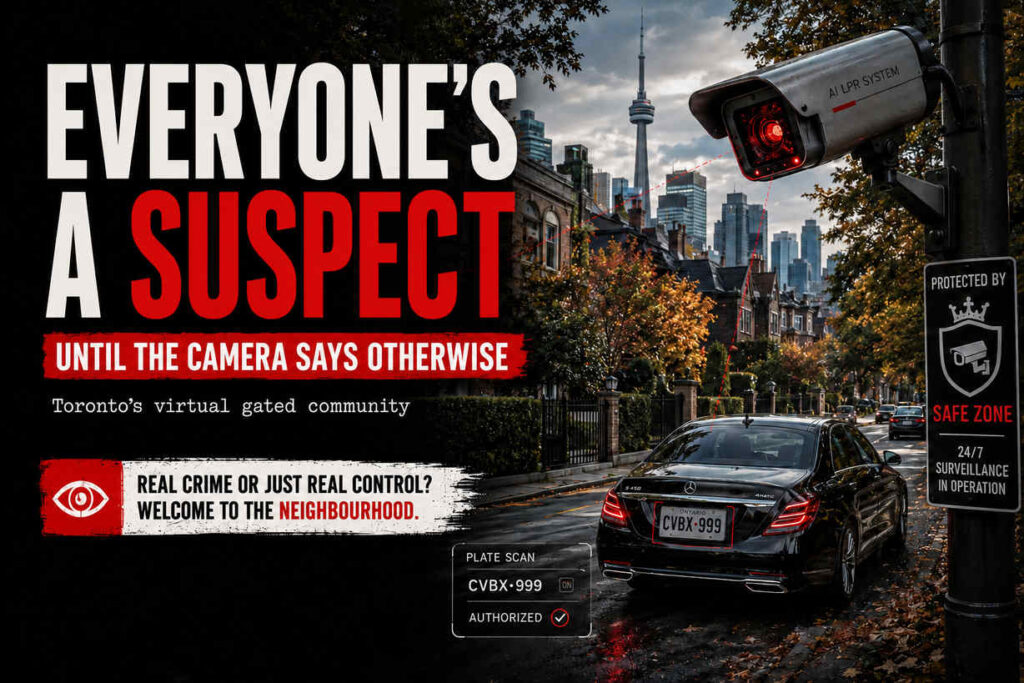
Toronto’s “virtual gated community” idea starts with real fears about crime — but ends with a bigger question: are we building safety, or just teaching neighbourhoods to watch everybody like they don’t belong?
Home invasions and car thefts are real. So is the fear. But Toronto’s “virtual gated community” idea raises a bigger question: when safety becomes surveillance, who gets watched, who gets protected, and who gets treated like they don’t belong?
Rosedale has never exactly been Toronto’s bargain bin. This is not a neighbourhood where people are refreshing rental listings at midnight, praying for a basement unit with “character” and one suspicious electrical outlet. It is one of those parts of the city where the hedges look better funded than some public services, the houses have names whether anyone admits it or not, and the sidewalks seem to understand tax brackets. So when a place like that starts talking about becoming a “virtual gated community,” it lands with a very specific Toronto flavour: wealthy neighbourhood already feels private, now wants software to make it official. But here’s the part we should not brush off just to get a cheap laugh: the fear is real. Home invasions are real. Car theft is real. Break-ins are real. People are allowed to be scared when criminals target their homes, their families, their vehicles, and their sense of safety. Nobody should have to live like that, whether they are in
Rosedale, Rexdale, Scarborough, Etobicoke, North York, Parkdale, or anywhere else in this city. The uncomfortable question is not whether people deserve protection. Of course they do. The question is whether protection now means turning neighbourhoods into AI-powered suspicion machines, where every driver, delivery worker, visitor, contractor, dog walker, Uber, nurse, cleaner, teenager, or lost person with a licence plate becomes part of a quiet little surveillance file. If Rosedale gets a virtual gate, what comes next? Forest Hill with facial recognition? The Beaches with drone patrols? A condo board in Liberty Village issuing threat levels because someone parked a Civic too slowly? Crime is a citywide problem. Fear is a citywide problem. But if the answer is “everyone gets watched until the camera decides they belong,” then Toronto is not just fighting crime anymore. It is auditioning for Big Brother with better landscaping.
The problem with turning neighbourhood safety into camera math is that cameras do not understand context. They do not know if you are a thief, a nurse, a contractor, a cousin dropping off groceries, a lost Uber driver, or some poor guy circling the block because Toronto’s one-way streets were apparently designed by a raccoon with a grudge. They see a plate. They compare a plate. They ping a system. And then everyone downstream is supposed to remember that the machine might be wrong — which is a lot of faith to put in humans already running on stress, coffee, and “suspicious vehicle” emails. In the United States, automatic licence-plate reader mistakes have already led to people being wrongly stopped, detained, or treated like threats because a camera misread a plate or matched bad data. Business Insider reported cases involving Flock Safety cameras where misreads and false alerts led to serious consequences, including wrongful detention and police stops. CBS News has also reported on ALPR mistakes and the need for manual verification before police act on a camera “hit.” And privacy groups like the Electronic Frontier Foundation have warned that these errors are not just little tech hiccups — they can become frightening real-world encounters for innocent people. So yes, the sales pitch may sound clean: cameras help catch bad guys. Lovely. Nobody is against catching bad guys. But when the system gets it wrong, it does not send an apology basket. It sends suspicion. It sends armed attention. It sends some innocent person into the worst customer-service experience of their life, except the customer service representative has handcuffs and a radio. (Business Insider)
And this is where the “virtual gate” starts sounding less like public safety and more like a Roomba with authority issues. Licence-plate readers have already produced some truly stupid real-world moments in the U.S., which is usually where every bad technology gets a trial run before being rebranded as “innovation” in Canada. Sometimes the camera misreads a plate. Sometimes the database is wrong. Sometimes glare, angle, dirt, shadows, or plain old human laziness turns an innocent driver into tonight’s featured suspect. CBS News found ALPR mistakes can come from a messy cocktail of machine errors and human errors, which is very comforting if your entire neighbourhood safety plan depends on the machine and the humans both not having a weird day. Business Insider reviewed cases where Flock-style camera errors or poor verification led to innocent people being stopped at gunpoint, jailed, or treated like threats. That is the part missing from the glossy brochure. The camera does not say, “Oops, sorry, I was confused by a dirty plate and the sun.” It says, “Alert.” Then people react. And suddenly some delivery driver, caregiver, contractor, or unlucky person trying to find Mount Pleasant is not just lost in Rosedale anymore — they are starring in a neighbourhood crime thriller they did not audition for.
Are we solving crime, or privatizing suspicion? Supporters will say the cameras help police find stolen vehicles and track suspects, and sometimes they probably do. That part matters. Nobody is sitting here cheering for car thieves like they are misunderstood artists with bolt cutters. If a camera helps recover a stolen vehicle or stop a break-in crew, people are going to say, “Great, finally, something worked.” Fair enough. But the problem is what comes bundled with that little victory lap. These systems do not just watch criminals. They watch everybody. They collect the boring, ordinary movements of regular people who did absolutely nothing except drive down a public street with the wrong postal-code energy. And that is where the whole thing gets slippery. Because once one neighbourhood gets a virtual gate, another neighbourhood will want one, then a condo board, then a business strip, then some “community safety partnership” with a name so harmless it sounds like a daycare fundraiser. Suddenly Toronto is not one city anymore. It is a patchwork of tiny surveillance kingdoms, each one deciding who looks normal, who looks suspicious, and who gets quietly logged because they had the nerve to turn left near a rich person’s hedge.
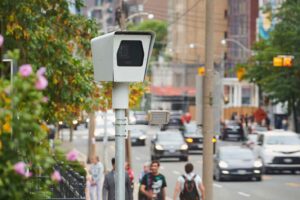
And let’s not kid ourselves: if this kind of “virtual gated community” gets treated as a success in Rosedale, it will not stay in Rosedale. That is not how Toronto-area anxiety works. It spreads faster than a condo pre-sale email. Forest Hill will want one. Lawrence Park will want one. The Kingsway will want one. Leaside will ask whether theirs can be “heritage compatible.” Then it starts moving across the GTA, because car theft and home invasions are not stopping at Steeles Avenue like they respect municipal boundaries. You can easily imagine parts of Oakville, Vaughan, Markham, Richmond Hill, Mississauga, Burlington, and Pickering looking at this and saying, “Actually, that sounds pretty reasonable,” especially in neighbourhoods where people already feel police response is too slow, car theft is too organized, and nobody in government has a plan that sounds stronger than “please lock your doors harder.” And that is where the experiment gets bigger than one rich Toronto pocket. Because once every anxious neighbourhood with money can buy its own surveillance layer, the GTA starts becoming a map of invisible checkpoints: not official gates, not police stations, not border crossings — just quiet little cameras deciding whose car belongs, whose car looks funny, and whose regular Tuesday drive is now part of somebody else’s safety spreadsheet.
So yes, protect people. Catch the thieves. Stop the break-ins. Make residents feel safe in their own homes. Nobody reasonable is against any of that. But maybe Toronto can aim a little higher than turning every quiet street into a low-budget spy movie with better brickwork. A neighbourhood should not need an algorithm at the curb deciding who belongs. A delivery driver should not need to pass an invisible vibe check to drop off pad thai. A visitor should not become a data point because they took the scenic route and accidentally entered a street where the shrubbery has generational wealth. Safety matters. So does privacy. So does not building a city where every solution comes with a camera, a dashboard, and a polite little promise that only the right people will be watched. Because if Toronto’s future is “virtual gates” everywhere, then congratulations: we did not fix the city. We just turned it into a condo board with Wi-Fi.
And because this is the GTA, you know exactly how this will go. Nobody will call it surveillance. That sounds creepy. They’ll call it a community safety innovation pilot, put it in a PDF with a smiling stock photo, and pretend the camera is just there to help. Very friendly. Very modern. Very “please ignore the fact that your minivan is now having a relationship with a database.” At this point, the only thing missing is a neighbourhood app that rates your suspiciousness out of five stars: one star for turning around in a driveway, two stars for driving slowly, three stars for a contractor van, four stars for out-of-area plates, and five stars for using Waze and accidentally entering Rosedale.
0 Comments
be respectfulNo comments yet. Start the discussion.