



From Protest to Parade to Political Mess: What Happened to Toronto Pride?
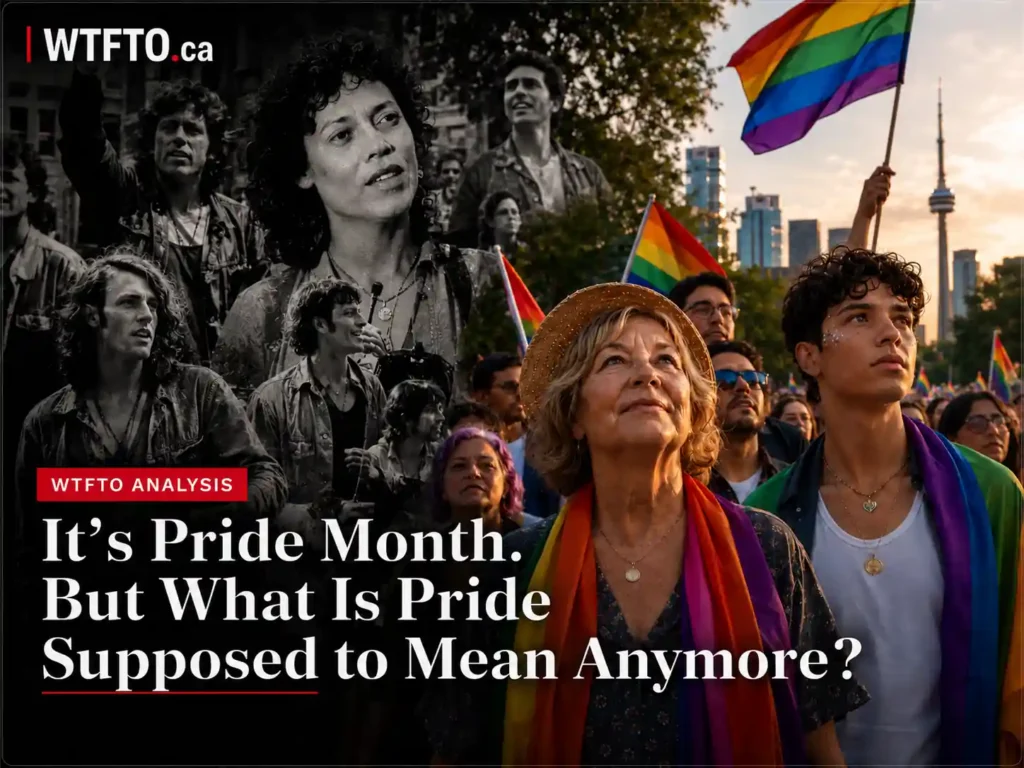
Pride was never supposed to be just a party. It was never supposed to be a month where corporations switch their logos to rainbow colours, politicians pose for cameras, and everyone pretends the hard part of history is safely over. Pride began as defiance: people who had been raided, shamed, threatened, fired, hidden, mocked, and treated like criminals choosing to step into public view anyway. Before it became a festival with floats, sponsorship tents, music stages, hashtags, and city-funded security plans, Pride Month was about something much more basic the right to exist openly without apology. That is the part Toronto needs to remember. Because when Pride becomes whatever the loudest group, the biggest sponsor, or the most nervous committee needs it to be in that moment, it starts drifting away from the people who paid the original price for it.
The modern Pride movement is usually traced back to around 1:20 a.m. on Saturday, June 28, 1969, when New York City police raided the Stonewall Inn, a gay bar in Greenwich Village, and the people inside and around it finally pushed back. It was not the first time LGBTQ people had been harassed, raided, humiliated, or arrested, and it was not the first time people had resisted. But Stonewall became the spark that carried. In those early morning hours, private fear turned into public anger, and public anger became a movement that refused to stay quiet. One year later, on June 28, 1970, the first Pride march was held to mark the anniversary of Stonewall. That march was not a polished celebration. It was a risky public declaration by people still living in a world that often treated them as criminals, outcasts, or jokes. That is why Pride Month exists in June — not because a marketing department picked a season, but because people fought back when being visible still came with a price.
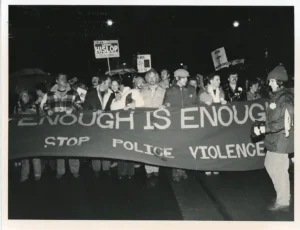
Toronto did not simply borrow Pride from New York. It had its own breaking point. At about 11 p.m. on Thursday, February 5, 1981, Metropolitan Toronto Police launched Operation Soap, a coordinated raid on four gay bathhouses in the city. Men were arrested, humiliated, and treated as if their private lives were public crimes. The 1981 bathhouse raids became one of the defining moments in Toronto’s LGBTQ history, not because they were isolated, but because they made something painfully obvious: gay men in Toronto were still being policed, exposed, and shamed as a community. The anger that followed helped shape Toronto’s modern Pride movement. So when Toronto talks about Pride, it should not start with floats, sponsors, stages, or politicians. It should start with the people who had their doors kicked in, their names dragged out, and their dignity put on trial and who still came back into the street louder than before.
The response was immediate. The next day, hundreds and then thousands of people took to the streets around Yonge and Wellesley, marched on police, and made it clear that Toronto’s gay community was not going to disappear quietly. Out of that anger came organization. Out of that humiliation came public resistance. And out of that resistance came something that would become much larger than the police expected. Later that year, Lesbian and Gay Pride Day Toronto was legally incorporated, and on Sunday, June 28, 1981, about 1,500 people gathered at Grange Park for what Pride Toronto describes as an afternoon to relax, celebrate, and reclaim space after a politically charged year. That matters. Toronto Pride was not born as a corporate street festival. It was born after people were pushed too far — and decided that the answer to shame was visibility.
Over time, Toronto Pride grew from a defiant community gathering into one of the city’s most visible annual events. The centre of gravity became the Church and Wellesley Village, but the meaning was always bigger than one neighbourhood. For people who had spent years hiding pieces of themselves at work, at home, at school, in churches, in families, and in public, Pride Toronto became a place where they could stand in daylight and not apologize for being there. It was protest, celebration, memorial, reunion, and relief all at once. That is what made it powerful. It was not only about being loud or colourful. It was about people who had been told to lower their voices finally realizing there were thousands of others standing beside them.
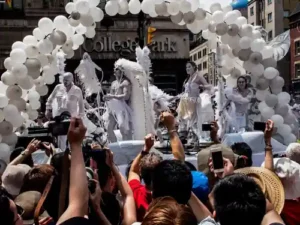
By 2014, Toronto Pride had become something the city could no longer treat as fringe. What began with small, defiant gatherings had grown into one of Toronto’s largest public events. By 2013, a City of Toronto report described Pride Toronto as drawing more than 1.2 million people over its 10-day festival, with the next year expected to be even larger. Then came WorldPride 2014, the first event of its kind ever held in North America. Pride Toronto estimated that 2 million people would attend activities across the festival, and Pride officials later said the event drew roughly 2 million visitors over nine days. For a moment, Toronto looked like it understood the weight of what it was carrying: international attention, massive crowds, a human-rights conference, and a message that the city wanted to be seen as open, modern, diverse, and proud. In a city that had once watched police raid bathhouses and drag people into shame, the festival was supposed to mean something bigger than tourism. It was supposed to be proof that the fight had changed the city. And in many ways, it had. But it also raised a harder question that Toronto still has not fully answered: when a protest movement becomes a major civic brand, who gets to control what it means?
That scale matters. Toronto Pride did not just become another summer event fighting for space on the civic calendar. It became one of the largest Pride festivals in the world, and with that came a different kind of pressure. The bigger it became, the more it needed sponsors, permits, security, politicians, tourism agencies, corporate floats, government support, and professional management. Some of that was necessary. A festival drawing crowds in the millions cannot run on goodwill and folding tables alone. But growth changed the feeling. Pride had started as a community refusing to be invisible. Now it was also a major civic product something Toronto could market, politicians could attend, corporations could brand, and institutions could use to show how progressive they wanted to appear. That is where the tension begins. Pride had won public visibility, but visibility came with a question: who was now steering the thing?
That is where Pride’s success became complicated. Once Toronto Pride became massive, it needed money, and that money had to come from somewhere. Sponsors helped pay for the stages, fencing, security, logistics, performers, permits, staffing, cleanup, and the kind of infrastructure a crowd that size requires. But sponsorship also changed the atmosphere. Suddenly, the parade was not only filled with community groups, drag performers, activists, families, survivors, elders, and people marching for visibility. It was also filled with bank logos, telecom banners, corporate booths, political photo ops, and safe, polished displays of support that looked carefully designed for cameras and social media. Some of that support was real and welcome. But some of it also started to feel like rainbow capitalism: a movement built by people who risked everything slowly being turned into a seasonal marketing opportunity. Pride needed support to survive at that scale. The problem is what happens when the support starts to look like ownership.
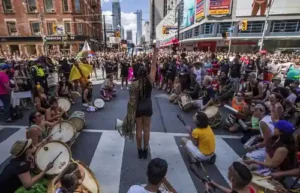
By 2016, that tension was no longer theoretical. During the Toronto Pride Parade that year, Black Lives Matter Toronto, which had been invited as an honoured group, stopped the march near Yonge and College and staged a sit-in. Their argument was political: they said Pride had problems with anti-Black racism, lack of representation, unequal funding for community spaces, and police participation in the parade. Those concerns deserved to be heard and debated seriously. But the tactic was something else. By stopping the parade and forcing the issue in the middle of Pride’s biggest public moment, the protest turned a hard-won day of LGBTQ visibility into an ultimatum. For many people watching, especially those who understood how much history Pride was carrying, it felt less like a conversation and more like a hijacking.
The timing made it worse. Just days before the 2016 parade, Toronto Police Chief Mark Saunders had publicly apologized for the 1981 bathhouse raids, more than three decades after Operation Soap helped define the broken relationship between police and Toronto’s gay community.. That apology did not erase the past. It did not mean every LGBTQ person trusted police. And it did not settle the harder questions about policing, race, protest, or public safety. But it was still a long-delayed act of institutional accountability, and for many people it felt like a fragile step toward reconciliation. That is why the Pride agreement was so damaging. Instead of letting Toronto work through that difficult moment with care, the parade was stopped, the issue was forced, and Pride leadership signed onto demands that included removing police floats and booths from future Pride events. A community that had finally pushed police into a public apology suddenly watched that same relationship get thrown back into conflict. That was not healing. That was a setback.
Then came the part Pride Toronto has never really shaken off: the agreement. In the middle of the stopped parade, Pride leadership signed onto a list of demands so the march could continue. Some of those demands dealt with funding, community spaces, representation, accessibility, and support for Black queer programming — issues that could have been debated properly. But the most explosive demand was the removal of police floats and booths from future Pride events. That was not a small procedural request. It struck directly at the fragile reconciliation Toronto had just begun to build after the bathhouse-raids apology. Pride Toronto could have said: we hear the concerns, we will hold public meetings, we will consult the broader community, and we will decide after the parade. Instead, the organization appeared cornered into signing a political agreement in real time, in front of cameras, while thousands of people waited. That is why the moment still matters. It made Pride look less like a community deciding its future and more like a movement being negotiated under pressure.
The fallout did not end when the parade started moving again. In 2017, after the previous year’s sit-in and the signed demands, Toronto police did not participate in the Pride parade. Chief Mark Saunders said he understood that LGBTQ communities were divided and that, to allow those differences to be addressed, the Toronto Police Service would not take part that year. That mattered, because it showed how quickly a reconciliation moment had turned into a public fracture. Some LGBTQ people and supporters believed uniformed police had no place in Pride because of the history of raids, surveillance, racism, and mistrust. Others saw police participation especially LGBTQ officers marching openly as a sign that the institution had been forced to change. Both views existed inside the community. That is what made the 2016 agreement so consequential. It did not settle a debate. It hardened one. Instead of Toronto carefully asking what police accountability, apology, and future participation should look like, Pride became a battleground over whether reconciliation itself was real, possible, or already compromised.
The deeper issue was that Pride was being asked to carry too many unresolved fights at once. The history with police was real. The anger from Black and racialized LGBTQ communities was real. The desire by some LGBTQ officers to march openly in their own city was real too. None of those truths cancelled out the others. But that is exactly why the 2016 moment needed careful leadership, not a forced decision made in the middle of a stopped parade. Pride is supposed to be big enough to hold grief, protest, celebration, apology, and disagreement. It is not supposed to be so fragile that one confrontation can rewrite the whole event. The failure was not that hard questions were raised. Hard questions belong at Pride. The failure was that Toronto’s biggest LGBTQ gathering became the place where those questions were settled by pressure instead of community trust.
The money problem did not come out of nowhere. It would be too simple to say Pride Toronto lost sponsors only because of the 2016 sit-in or the fight over police participation. The more accurate problem is bigger than that. By the time corporate sponsors began pulling back, Pride had already become a massive, expensive, politically loaded event that depended on institutions it could not fully control. In 2025, Pride Toronto faced a reported $900,000 funding shortfall after major sponsors withdrew or reduced support, part of a wider retreat from public diversity, equity and inclusion and Pride spending. But that shortfall exposed something Toronto should have seen coming: when a movement becomes a mega-festival, every controversy, every sponsor decision, every political shift, and every budget problem becomes a threat to the whole thing. Pride had grown into one of the city’s biggest public events, but its foundation was no longer just community strength. It was corporate money, government funding, public permits, police and security costs, insurance, staging, and a long list of fragile partnerships. That is not independence. That is dependence with rainbow lighting.
And then there is the accountability problem. Pride cannot ask the public, governments, sponsors, and the community to keep rescuing the festival if people do not trust how the organization is being run. In 2022, Pride Toronto apologized after an independent review found problems with how it handled federal grant money, including an inability to prove that several funded projects had actually been completed. By 2024, the organization was reportedly repaying more than $505,000 to the federal government after receiving $1.85 million in grants. That does not mean Pride itself is no longer important. It means the opposite. If Pride matters, then the people running it have a higher duty to be transparent, careful, and accountable. A movement built on public trust cannot afford to look careless with public money.
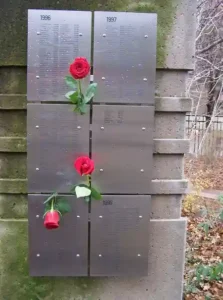
That is why so many older LGBTQ people look at Pride today with a complicated kind of sadness. For Baby Boomers, Gen X, and even older Millennials, Pride is not an abstract symbol. It is tied to memories of police raids, workplace fear, family rejection, hidden relationships, funerals, and the AIDS crisis. In Toronto, groups like the AIDS Committee of Toronto were created because the community had to organize when fear, stigma, and silence were still everywhere. The Toronto AIDS Memorial exists because Pride was never only about celebration; it was also about remembering people who were lost, naming them publicly, and refusing to let shame write the history. So when Pride becomes mostly a funding crisis, a sponsor problem, a political battlefield, or a branding exercise, older generations notice. They remember when Pride was not fashionable. They remember when it was necessary.
That does not mean Pride should be frozen in 1981, or 1994, or 2014. Movements change because people change, language changes, families change, laws change, and new generations bring their own fights into the street. That is not the problem. The problem is when change becomes disconnection. Pride can grow, expand, include more voices, and still remember the people who made it possible. It can honour trans communities, racialized communities, newcomers, youth, elders, survivors, families, and allies without losing the central truth that Pride began as an LGBTQ fight for dignity and public existence. Toronto has places like The ArQuives and The 519 because memory matters. Without that memory, Pride becomes easy to rebrand, easy to politicize, easy to sell, and easy to forget. And once a movement forgets its own history, everyone else gets to define it for them.
That generational gap matters. Many younger people have inherited Pride as a public celebration, not as a dangerous act of survival. They know the parade, the flags, the language, the social media posts, the school clubs, the corporate logos, and the official statements. But many did not live through the years when being openly gay, lesbian, bisexual, trans, or queer could cost someone their job, their family, their housing, their safety, or their name in the newspaper. That does not make younger generations the enemy. It means they were born into some of the progress older generations fought to create. But progress can create its own kind of amnesia. When the danger fades from memory, Pride can start to look like a party, a brand, or a political stage instead of what it was first: a public refusal to disappear.
That is where Toronto Pride has to find its way back. Not backward, but back to centre. Pride does not need to become smaller, quieter, or less inclusive. It does need to become clearer about what it is. It cannot be everything to everyone at once: a corporate showcase, a political battlefield, a tourism campaign, a public funding emergency, a protest space, a street party, a remembrance ceremony, and a brand-safe summer festival all at the same time without eventually losing the thread. At its core, Pride has to belong first to the LGBTQ people who needed it before it was popular, before it was profitable, and before it was safe.
Toronto should not let Pride become just another event that shows up every June, paints the city rainbow, asks for money, absorbs every political fight in sight, and then disappears until next year. Pride was built by people who refused to disappear. That is still its power. The sponsors, politicians, committees, activists, police, corporations, and governments all have their place in the story, but none of them should be allowed to take the centre away from the people who made Pride necessary in the first place. If Pride Month is going to mean anything now, it has to mean memory, courage, dignity, accountability, and community — not just celebration, not just controversy, and definitely not just branding. Toronto Pride still matters. But it matters most when it remembers why it had to exist at all.
0 Comments
be respectfulNo comments yet. Start the discussion.