



THE PARKING & ELECTRIC FUTURE INVESTIGATION — PART 5: TORONTO’S FRONT-YARD PARKING DOUBLE STANDARD
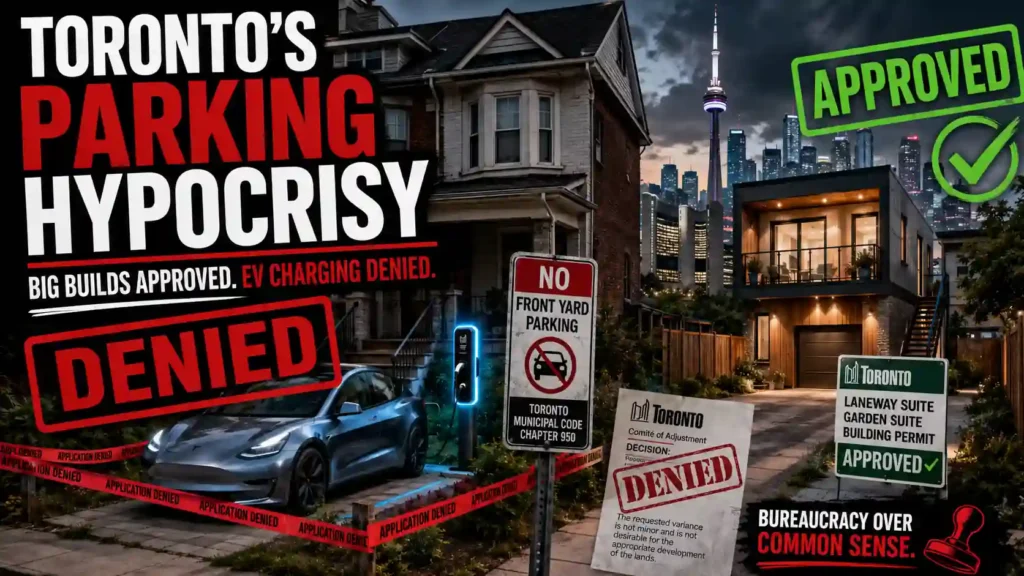
Toronto says it wants an electric future. Its front-yard parking rules tell thousands of homeowners to keep circling the block.
Toronto Already Knows It Has a Driveway Lottery
In Part 1 of The Parking & Electric Future Investigation, WTFTO exposed Toronto’s driveway lottery: a system in which one homeowner may legally install a front-yard parking pad while another, living only a few streets away in a nearly identical house, may not even be allowed to apply.
The difference is not always the size of the property, the amount of available space, the drainage conditions or the presence of trees.
Often, it comes down to geography, former municipal boundaries and political decisions inherited from a Toronto that officially disappeared when the city amalgamated in 1998.
That was the first problem.
In this Part we examines the larger one.
Toronto is now promoting electric vehicles, expanding public charging and asking residents to reduce transportation emissions. But for thousands of homeowners without driveways, the City’s own parking rules can prevent them from creating the private space needed to charge an electric vehicle at home.
The contradiction is no longer theoretical.
Toronto has had years to modernize its rules, recognize permeable materials and judge parking-pad proposals according to drainage, landscaping, tree protection and pedestrian safety.
Instead, many residents are still governed by a municipal patchwork in which an address can matter more than the actual design being proposed.
To understand how Toronto arrived at this point, you have to look past the City’s environmental talking points and examine what the bylaws actually do.
What the Bylaw Really Means — Without the Municipal Gobbledygook
Strip away the legal language and Toronto’s system works like this: there is not one clear front-yard parking rule. There are two overlapping rulebooks — Zoning By-law 569-2013 for private property and Municipal Code Chapter 918 for licensed parking pads and the City boulevard — and the answer can change depending on whether a house sits inside the old, pre-amalgamation City of Toronto. Toronto became one city in 1998. Its parking rules apparently missed the memo.
In some neighbourhoods, the City will at least look at an application. In designated moratorium areas, Chapter 918 can direct staff not to accept certain applications at all. That is not the City reviewing a drainage plan and finding it unsafe. It is the City refusing to open the folder. You do not get to show your permeable pavers, tree plan or engineering. Your address landed on the wrong side of an old political line, so the conversation can be over before it begins.
Where applications are accepted, homeowners enter a municipal obstacle course: existing-driveway rules, arterial-road restrictions, permit-parking occupancy tests, landscaping percentages, tree requirements, curb-ramp conditions, petitions and, in some cases, a neighbourhood poll. The current City application turns a one-car parking space into a small planning thesis. In plain English, a homeowner may have to prove the pad is safe, environmentally responsible and locally popular — while a nearly identical legal pad already sits three streets away.
This is where the bylaw stops looking like environmental protection and starts looking like bureaucracy protecting itself. If runoff is the concern, require permeable paving and drainage. If a tree is at risk, require an arborist and protect the root zone. If sightlines or pedestrian safety are a problem, inspect the design and reject it for a real reason. But refusing even to consider a proposal because of a decades-old boundary is not a modern environmental test. It is municipal archaeology.
The City also tightened the system in 2022. A route that had allowed some homeowners to seek a minor variance through the Committee of Adjustment was largely closed inside the former City of Toronto. The City’s own 2022 technical report explains the change and its grandfathering rules. So this is not merely a dusty bylaw nobody noticed. Council recently chose to reinforce the wall around it.
There was a legitimate reason for regulating old-style parking pads. Nobody is asking Toronto to let every homeowner pour asphalt over the lawn and call it progress. But a blanket prohibition treats a modern, permeable, landscaped design as though it were the same slab of blacktop that caused the problem decades ago. The technology changed. The climate policy changed. The housing pattern changed. The bylaw mostly did not.
The sensible replacement is not open season on front lawns. It is one citywide, property-by-property standard: one space, safe access, permeable materials, protected trees, meaningful landscaping, proper drainage and an electrical inspection where charging is installed. If the design meets the standard, approve it. If it fails, reject it with a technical reason — not a postal code and a history lesson. The homeowners most affected are the same residents identified in Part 1: people living in older Toronto neighbourhoods where houses were built without driveways, rear-laneway access is limited or nonexistent, and curbside permit parking has become the only practical option.
Part 1 established how those residents became trapped in Toronto’s driveway lottery. The question now is whether the environmental reasoning used to defend that system still holds up when measured against the much larger developments the City routinely approves.
The Environmental Argument
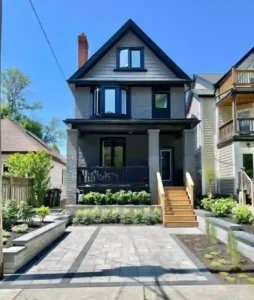
Toronto’s restrictions are usually defended on environmental grounds: protecting trees, preserving soft landscaping, reducing stormwater runoff and maintaining safe residential streets.
Those are legitimate concerns. No responsible parking policy should allow homeowners to pave entire lawns, damage mature trees or send additional runoff into an already strained drainage system.
But acknowledging those concerns does not end the discussion.
The real question is whether Toronto applies them consistently.
When the City supports a larger development, environmental impacts are studied, engineered and managed through conditions. Drainage systems are designed. Landscaping percentages are established. Trees are assessed. Variances are considered.
But when a driveway-less homeowner proposes one small, permeable and landscaped parking space, those same environmental issues can suddenly become a reason to refuse the application before the design is even examined.
That is where environmental protection begins to look less like a consistent standard and more like a convenient justification.
Harsh Reality Check: When City Hall Wants It, the Environment Becomes Flexible
Toronto’s environmental concern has a funny habit: it becomes a manageable engineering problem when City Hall wants a project, and an immovable moral principle when a homeowner wants one legal place to charge a car. Here is the hypocrisy without the planning-department perfume.
Garden suites: Toronto’s garden-suite rules allow a backyard house with a footprint of up to 60 square metres or 40 per cent of the rear-yard area. On lots six metres wide or narrower, only 25 per cent of that rear area must remain soft landscaping. That can mean a foundation, walls, a roof, plumbing, electrical service and walkways. But a roughly fifteen-square-metre permeable parking pad is treated like an ecological crime scene. Apparently concrete becomes environmentally sophisticated once it has a kitchen.
Laneway suites: The City’s own laneway-suite review discusses soft landscaping, stormwater, tree-growing space and heat-island effects. Toronto did not respond by banning laneway houses. It created standards, considered variances and used mitigation such as green roofs. When City Hall wants housing, engineering solutions suddenly exist. When a resident wants one EV space, every blade of grass becomes sacred.
Multiplexes: Toronto now permits multiplexes of up to four units citywide. These projects can involve additions, more servicing and greater use of a residential lot. Fair enough—the city needs housing. But that is exactly the point: larger projects receive rules, reviews and workable conditions. A much smaller parking pad can receive a moratorium and a slammed door. The environmental impact is negotiable whenever City Hall likes the policy objective.
Toronto’s own numbers: A 2017 City report estimated licensed front-yard parking pads produced about 0.7 per cent of stormwater runoff from low- and medium-density areas. Ordinary driveways serving garages and other on-site parking represented about 17 per cent. The report also noted that newer licensed pads used semi-permeable materials and more soft landscaping. So the supposed environmental monster contributes a tiny fraction of the runoff created by driveways Toronto already accepts.
This is not an argument against laneway homes, garden suites or multiplexes. Build them. Toronto needs housing. It is an argument against selective environmentalism. The City has already proven it knows how to measure impacts, impose conditions and approve a project with safeguards. It simply refuses to use the same common sense for driveway-less residents trying to charge an electric vehicle. That is not green planning. It is policy hypocrisy wearing a rain barrel as a hat.
What a Modern Parking Pad Actually Looks Like
When many people hear the phrase front yard parking pad, they still picture the old model that helped inspire the original restrictions decades ago: a patch of asphalt poured over a lawn, with little consideration for drainage, landscaping, or environmental impact. But modern parking pad designs are very different from those early examples. Today, engineered parking pads can be built using permeable paving systems that allow rainwater to pass through the surface and filter back into the soil below rather than running directly into storm drains. These systems often include layered gravel or drainage bases that help manage water flow, landscaped borders that maintain green space, and careful placement to protect nearby tree root zones.
In practice, a modern front yard parking pad can function more like a designed landscape feature than a simple parking surface. Permeable pavers, reinforced grass systems, and integrated drainage materials are already widely used in environmentally sensitive developments, including pedestrian pathways, courtyards, and residential driveways across the city. The irony is that many of the same engineering solutions that allow other types of development to move forward—particularly projects designed to manage stormwater—could also be applied to front yard parking pads. Yet even when homeowners propose designs built around these modern environmental standards, approvals are often difficult to obtain in neighbourhoods where front yard parking has historically been unpopular or politically contentious.
Toronto Wants Electric Cars — But Not a Place to Charge Them
Here is where the bylaw crosses from outdated into absurd. Toronto’s climate policy calls for net-zero emissions by 2040 and targets 30 per cent of registered vehicles being electric by 2030. The City’s 2026 public-charging plan even identifies “public-charging-dependent drivers” — residents who do not have private parking or home charging — as a group the network must serve. In other words, City Hall knows exactly who is being left without a plug.
Yet the same city prevents many driveway-less homeowners from creating the one thing that would reduce that pressure: a legal, privately paid, EV-ready parking space on their own property. Toronto is effectively saying, “Please buy the cleaner car — but depending on your neighbourhood, do not expect us to let you plug it in at home.” That is not a transition plan. That is a contradiction with a charging cable attached.
The Green P charging page advertises more than 430 off-street and more than 100 on-street EV stations by the end of 2025. The City’s 2026 report says 589 City-owned chargers were in the network awaiting integration into the new program. Those numbers sound impressive until they are spread across a city of millions and shared by residents, commuters, visitors, taxis and delivery vehicles. A dot on a charging map is not a plug sitting empty and waiting for you.
For a resident without a driveway, charging can mean hunting for a station, hoping it is working, hoping another car is not using it, paying for the electricity and possibly the parking, waiting, and then moving the vehicle when it is done. The City’s own 2026 plan acknowledges congestion and queuing when chargers are slow or vehicles remain plugged in longer than necessary. That is not the convenience of home charging. It is a weekly scavenger hunt for electricity.
The shortage is not just about the total number of chargers. It is about whether a reliable charger exists where a driveway-less resident actually lives and whether it is available overnight. The City’s 2026 plan admits charging needs vary with access to at-home parking and that private-market delivery may be limited or inequitably distributed. Toronto knows the gap exists. Its parking bylaw helps keep that gap open.
At an absolute minimum, Toronto should create a citywide EV-ready exemption for homes without legal off-street parking. Allow one licensed front-yard space when the owner installs an approved charger and meets strict requirements for permeable paving, landscaping, tree protection, drainage, pedestrian safety and electrical work. The licence could require the space to remain EV-equipped. That is not a free-for-all. It is a controlled, environmentally stricter path for residents trying to do exactly what the City claims it wants.
Every home charger installed at the owner’s expense is one less driver competing for a scarce public plug. A city serious about emissions should make the cleaner choice easier. It should not force residents to fight over shared chargers while an environmentally designed parking space on their own property is forbidden by a rule inherited from another municipal era.
The Politics of the Curb
Part 1 showed the result of Toronto’s driveway lottery. Chapter 918 shows how that lottery became embedded in the law.
The code does not read like one modern policy designed for one amalgamated city. It reads like a scrapbook of political compromises accumulated over decades: former-municipality boundaries, neighbourhood prohibitions, pilot areas, street-specific exceptions and permissions written for individual addresses.
Some residents are allowed to submit an application, demonstrate proper drainage, protect nearby trees and propose permeable materials. Others can be rejected before the City examines any of those things.
That is the central problem.
A genuine environmental policy would apply the same measurable standards across Toronto. It would assess the property, the proposed surface, the landscaping, the drainage, the tree canopy and pedestrian safety.
Instead, the outcome can still depend on decisions inherited from old ward politics and a municipal map Toronto officially abandoned in 1998.
That is not equal treatment under one coherent environmental standard.
It is municipal archaeology with licence fees.
And now that access to private parking also determines access to reliable home charging, those old political compromises are no longer merely deciding where a gasoline-powered car may sit. They are deciding which Toronto residents can realistically participate in the electric transition.
The System Toronto Chose to Preserve
Toronto already has thousands of licensed front-yard parking pads. That proves the City can regulate them, inspect them, collect fees and maintain a registry without treating every parking space as an environmental disaster.
Yet Toronto has preserved a system in which access is not determined by one citywide engineering test. One address receives a full review; another can be rejected before the design is even examined.
The problem is no longer that the City lacks the tools to manage front-yard parking. It is that Toronto continues to ration those tools according to old boundaries and political history.
The Question Toronto Can No Longer Dodge
Toronto cannot keep preaching an electric future while regulating home charging with rules dragged out of the municipal past.
This is Canada. Winter is not a minor inconvenience. Cold weather reduces EV range, increases energy use and makes reliable charging more important—not less. For homeowners without a legal driveway or parking pad, access to dependable overnight charging can determine whether owning an electric vehicle is practical at all.
Apparently, City Hall’s solution is to promote EV adoption, declare a climate emergency and target 30 per cent electric vehicles by 2030—while telling thousands of residents to circle the block, hunt for an available public charger and hope nobody else got there first.
Brilliant plan.
Perhaps Toronto is waiting for climate change to solve the problem for it. Once the city becomes tropical and winter disappears, maybe cold-weather battery loss will no longer matter. Until then, residents are expected to buy electric vehicles without being given a realistic way to charge them.
If runoff is the concern, regulate runoff. If trees are at risk, protect them. If pedestrian safety matters, inspect the access. These are measurable issues with technical solutions. A decades-old neighbourhood moratorium is not an environmental assessment. It is lazy government disguised as policy.
Chapter 918’s patchwork should be replaced with one citywide, property-by-property approval standard. Toronto should create a tightly controlled EV-ready option for homeowners with no legal off-street parking: one space, permeable materials, meaningful landscaping, protected trees, proper drainage, safe pedestrian access and inspected electrical work.
This is not a demand to pave every lawn. It is a demand that City Hall stop hiding behind fossilized rules and judge the property in front of it—not ward politics, dead municipal borders and the asphalt mistakes of another century.
Toronto wants the applause for climate leadership without doing the inconvenient work required to make electric vehicles practical.
Its message to residents is simple: buy the EV, save the planet—and charge it somewhere else.
0 Comments
be respectfulNo comments yet. Start the discussion.