



Toronto Let a Stadium-Sized Problem Through. Now It Wants to Build a Wall Around It.
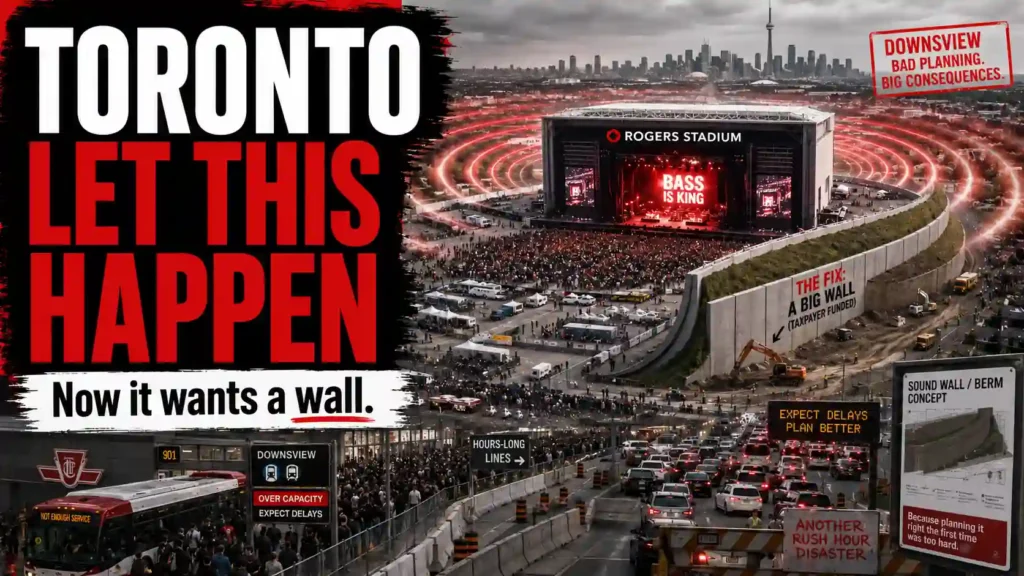
A 50,000-person concert venue was allowed onto a former airport runway without a full public debate. Now the bass is travelling for kilometres, residents are furious, and Toronto is studying how to contain a problem it should have examined before the first ticket was sold.This is not an anti-concert story. It is not an attack on music fans, performers or the people working at Rogers Stadium. Toronto should be able to host major artists, create jobs and bring new life to underused land.
This is about Toronto’s favorite style of governance: allow something enormous to happen, celebrate it as progress, ignore the obvious questions, and then act shocked when the consequences arrive.
Live Nation built and operates Rogers Stadium on land owned by Northcrest Developments. The City did not construct it. But Toronto’s rules allowed the 50,000-person outdoor venue to move forward under existing zoning and temporary-structure permissions without a specific City Council vote. That distinction does not excuse City Hall. It exposes the failure.
The project was technically permitted. The planning was still stupid.
Rogers Stadium did not quietly appear behind a neighbourhood bar. It was built on an exposed former airport runway, on roughly 44 acres, with enough capacity to empty a small city into Downsview on a single night. Yet Toronto reached opening day without fully answering two basic questions: how would 50,000 people get out, and where would all that sound go?
The paperwork may have been in order. Common sense was not.
The Runway Was the First Warning
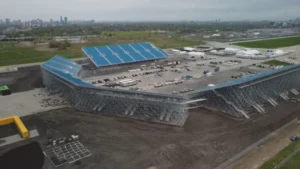
The word “temporary” has been treated like a magic trick throughout this project. Rogers Stadium is seasonal and expected to remain for only several years while the former airport lands are redeveloped. Somehow, that was allowed to make the project sound smaller.
It is not smaller.
Fifty thousand people are still 50,000 people whether the seats remain for five years or fifty. A temporary stadium still requires permanent-quality planning for transit, pedestrian movement, emergency access, traffic, noise and the surrounding neighbourhoods.
When the venue opened in June 2025, Live Nation promoted its access to highways and public transit. Fans were encouraged to leave their cars behind. Free rides home were arranged on the TTC and GO Transit, and extra service was promised.
It sounded organized until the first major crowd tried to leave.
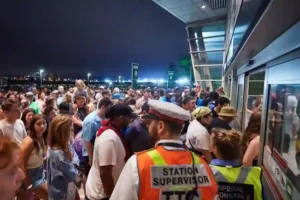
After the inaugural concert, some attendees said it took up to two hours to exit the site. Crowds stalled, nearby stations became congested, rideshare pickups became difficult, and fans faced long walks and confusing routes. At later concerts, people were held inside the grounds and released in controlled groups to prevent the nearest station from being overwhelmed.
Toronto allowed a venue for 50,000 people and then seemed surprised that 50,000 people would want to leave at roughly the same time.
That is not a minor opening-night inconvenience. Crowd movement is not an optional detail to be figured out after the stage is built and the tickets are sold. It is one of the first things competent planners settle.
Instead, the public became the stress test.
The stage was ready. The corporate signs were glowing. The politicians had attended the announcement. The exit plan appeared to be in beta testing.
Changes followed. For the 2026 season, the TTC added a new pedestrian route between Gate 2 and Sheppard West Station, increased service and staffing, and added a shuttle between Wilson Station and the stadium. Those are sensible improvements.
They are also improvements that should have been fully planned and tested before opening night.
Toronto does not deserve applause for gradually discovering the basic requirements of moving a crowd everyone knew was coming.
And transportation was only the first warning. If planners underestimated how people would move across an open runway, they also underestimated how sound would move across it.
The Sound Did Exactly What Sound Does
Once the concerts began, the sound did not politely stop at the property line.
Residents in Downsview, York Centre and Willowdale reported booming music and low-frequency bass entering their homes. Complaints later came from Thornhill and Vaughan. After a Bruno Mars concert in May 2026, CityNews reported that a resident near Bathurst Street and Highway 7 — roughly 11 kilometres from the venue — initially thought the noise was coming from a car in her neighborhood.
It was coming from Rogers Stadium.
Eleven kilometers away, people were not describing a faint melody floating through the night. They were reporting heavy bass inside their homes.
Live Nation pointed to the weather. Temperature, humidity, cloud cover, wind direction and atmospheric inversions can all affect how far sound travels, especially low frequencies. That explanation may be scientifically valid.
It is also not a defence.
Weather may explain how the sound travelled. It does not explain why a giant outdoor venue built on an exposed Toronto runway was not designed for Toronto weather in the first place.
Humidity was not invented after the stadium opened. Clouds did not suddenly arrive over Downsview. Rain did not file the building application. People chose the location, the layout and the sound system. Those people were supposed to anticipate what would happen when amplification, open land and real weather met on the same night.
Before opening, residents were told that engineers had considered the sound. The stage and speakers were positioned to direct noise away from homes, and berms, scaffolding and monitoring were supposed to limit the impact. After the first season produced complaints, Live Nation added vinyl cladding behind parts of the grandstands.
The complaints came back.
Following the Bruno Mars shows, Councillor James Pasternak said the measures adopted over the previous year were not delivering the expected results and suggested there were probably design flaws in the stadium itself.
That should stop City Hall cold.
Design flaws are supposed to be found during design — not after two concert seasons, repeated complaints and bass reaching another municipality.
Who reviewed the acoustic model? Was low-frequency sound tested under different weather conditions? Were measurements taken beyond the immediate neighbourhood? Why is an independent review being ordered only now?
Those are not unreasonable demands from people who hate music. They are the questions that should have been answered before opening night.
Instead, residents became unpaid acoustic monitors. Families in bedrooms, living rooms and backyards discovered how far the sound travelled, called 311 and waited while the City and the operator tried to understand a problem that should already have been understood.
That is not careful planning. It is municipal trial and error, with the public forced to live inside the error.
Toronto’s Solution: Build Another Thing
Now Toronto has arrived at its traditional solution: build something else around the thing that was not properly planned in the first place.
On June 25, 2026, City Council voted 24–0 for a motion directing the City Manager to work with Live Nation on an independent acoustic review. The motion calls for experts to examine the stadium’s physical layout, recommend capital improvements and sound-control technology, explore a sound-barrier berm, and consider stationary monitoring in neighbourhoods with a history of complaints.
There is something perfectly Toronto about the sequence.
The venue opened. The crowds bottlenecked. The bass travelled. Residents complained. Cladding was added. The complaints continued. Only then did City Hall move toward an independent review of the physical design.
This is not planning. This is municipal damage control with an architectural budget.
Council’s direction is that Live Nation should pay for the expert work, monitoring and improvements. Good. That is exactly where the cost belongs.
If the stadium needs more cladding, a berm, a wall, different speaker systems, structural changes or a redesigned sound plan, Toronto property taxpayers should not receive the bill. This is a privately operated entertainment venue. The operator and private interests behind it should pay to keep its noise out of people’s homes.
But even that principle has started to wobble. Pasternak told TorontoToday that if Live Nation refused to pay, he would consider asking the Ontario government to contribute because the venue creates economic activity.
Stop right there.
The province does not manufacture money. The City does not manufacture money. Government money is public money. Moving the invoice from City Hall to Queen’s Park does not make the taxpayer disappear.
No municipal or provincial money should be used to correct a private design problem. Not through a direct grant, not through an “economic development” program, and not through a creative funding arrangement that lets everyone claim the public did not technically pay for the wall.
Live Nation says its concerts operate within Toronto’s permitted sound limits and that it pays for Municipal Licensing officers to monitor shows. That may be true. It also exposes another problem.
If the official readings say everything is compliant while residents kilometres away are hearing and feeling bass inside their homes, then the rules are measuring the wrong thing, in the wrong places, or in the wrong way.
Compliance is not the same as success.
The purpose of a noise bylaw is not to produce a satisfactory number on a clipboard. It is to protect people from unreasonable disturbance. When the paperwork says everything is fine but the windows are still vibrating, Toronto should question the paperwork — not the residents.
Technically Permitted. Politically Orphaned.
Here is where the Rogers Stadium story becomes peak Toronto.
According to Pasternak’s public FAQ, the former airport lands were already zoned Commercial-Residential. That zoning permitted a music venue and a temporary structure of up to three storeys. Because the use and structure fit those rules, the project did not require approval by City Council.
Pasternak says he did not approve the stadium, was not alerted to the building application or review process, and learned about it only a few weeks before it was announced publicly.
Read that again.
A 50,000-person outdoor stadium was being prepared on a former airport runway, and the councillor representing the surrounding community says he did not know until shortly before the public announcement.
How does a project large enough to affect subway service, road closures, pedestrian movement, policing, bylaw enforcement and neighbourhoods kilometres away move through Toronto’s system without triggering a full public debate?
The bureaucratic answer is that the zoning allowed it.
The no-bullshit answer is that Toronto’s rules were not designed to properly examine something of this scale, and nobody stopped long enough to admit it.
A zoning category saying “music venue” should have been the beginning of the review, not the end. A small temporary performance space and a 50,000-person outdoor stadium may both fit the same label, but pretending they create the same impact is absurd.
The permits may have been valid. The plan was still stupid.
Then the same lack of ownership continued after residents complained. The Council motion itself says Toronto lacked an integrated, consistent response and that 311 and Municipal Licensing were giving residents contradictory information about the noise bylaw, exemptions and enforcement.
Toronto allowed the venue to operate but could not give the public one clear answer about what to do when the bass entered their homes.
That is a bureaucracy working exactly as bureaucracies like to work. Everyone has a phone number. Everyone has an email address. Everyone has a department. Somehow, nobody owns the problem from beginning to end.
The property owner can say the use was permitted.
The operator can say it followed the rules.
City staff can say the technical requirements were met.
The councillor can say Council never approved it.
Council can now vote to investigate the consequences.
Everyone has an explanation. Nobody owns the mistake.
That is Toronto’s favourite form of accountability: divide responsibility among so many departments, corporations, permissions and technical processes that by the time the public asks who made the decision, the decision no longer appears to belong to anyone.
City Hall will now commission studies. Staff will write reports. Experts will recommend barriers. Officials will promise better communication. Eventually, the repair may be presented as proof that government is working.
No.
Government working would have meant asking the hard questions before the stadium opened.
Government working would have meant testing the transportation plan before thousands of fans became the first real-world trial.
Government working would have meant understanding how low-frequency sound would travel before residents became monitoring equipment.
Fixing a mistake after the complaints pile up is not good planning. It is cleanup.
Temporary Stadium. Permanent Lesson.
Rogers Stadium has benefits. It brings major artists to Toronto, employs people, supports nearby businesses, attracts visitors and gives fans a large purpose-built concert venue. Local schools and music programs have reportedly received grants and scholarships.
Those benefits matter. They are not a permission slip for bad planning.
“Temporary” does not mean consequence-free. It does not mean transit can fail, bass can travel for kilometres, and residents can spend several summers fighting through a complaint system before City Hall decides the issue deserves a proper review.
The stadium may be dismantled around 2030 as the land is redeveloped. But several years of disrupted streets, crowded transit, bureaucratic runaround and unwanted bass are not temporary to the people living through them.
Toronto should release the acoustic and transportation studies, identify who reviewed and signed off on the plans, explain why the original safeguards failed, and guarantee that public money will not be used to correct a privately created problem.
Anything less is another Toronto specialty: hide the mistake inside a report, spread responsibility across ten desks and wait for the public to become exhausted.
| Toronto did not need a wall after the concerts started.
It needed competent planning before the first ticket was sold. |
Hello just wanted to give you a quick heads up. The text in your content seem to
be running off the screen in Opera. I’m not sure if this is a
formatting issue or something to do with internet browser
compatibility but I thought I’d post to let you know.
The style and design look great though! Hope you get the issue solved soon.
Thanks
Nice blog here! Also your web site loads up very fast!
What host are you using? Can I get your affiliate link to your host?
I wish my web site loaded up as quickly as yours lol
I’m truly enjoying the design and layout of your blog.
It’s a very easy on the eyes which makes it much more pleasant for me to come here and visit more often. Did you hire out a developer to create your theme?
Great work!