



Toronto’s Drug Crisis Has a 200-Metre Buffer | But No Real Plan
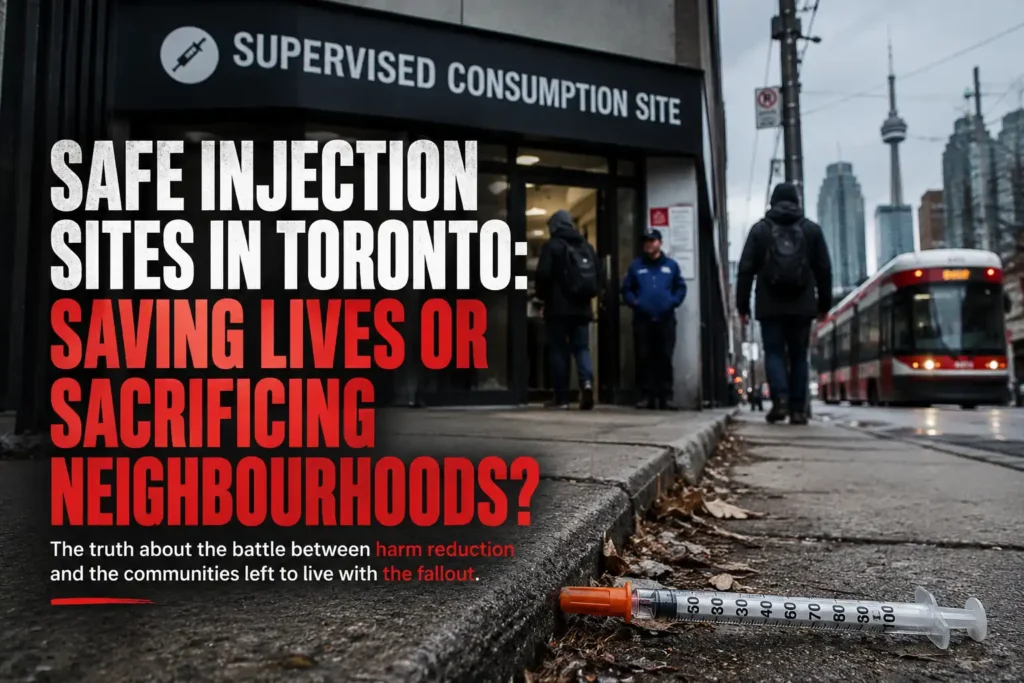
The Drug Crisis Didn’t Close — It Just Changed Addresses
Toronto’s supervised consumption sites were built on a simple but uncomfortable argument: the drug crisis already exists, whether politicians, neighbours, or businesses like it or not. The idea was not to approve of drug use, normalize it, or pretend addiction is harmless. The argument was that if people are already using dangerous street drugs, it is better to have them do it inside a monitored health-care setting, where staff can respond to overdoses, provide basic medical support, reduce disease risks, and connect people to treatment, housing, mental-health services, and social supports. In other words, the point was not to make the crisis disappear. The point was to stop more people from dying alone in alleys, washrooms, shelters, stairwells, parks, or on Toronto sidewalks.
Then Ontario changed the rules. Under the Community Care and Recovery Act, 2024, the province banned supervised consumption sites from operating within 200 metres of schools, child-care centres, EarlyON child and family centres, and other protected places. The law did not technically erase every supervised consumption site in Ontario, but it forced major closures and made it much harder for municipalities to support new or renewed supervised-consumption applications without provincial approval. In Toronto, that meant Toronto Public Health’s own supervised consumption service at The Works was ordered closed by March 31, 2025, with the City saying it no longer offered supervised consumption services there as of April 1, 2025. The province’s replacement model, HART Hubs, focuses on treatment, recovery, housing, and addiction supports — but not supervised consumption.
So what actually closed — and what stayed open?
The Ontario law did not remove supervised consumption from Toronto completely, but it changed the map. Before the provincial crackdown, Toronto had a wider network of sites spread through several downtown neighbourhoods. After the Community Care and Recovery Act, the picture became narrower: some locations were forced out because they were too close to schools or child-care settings, while others remained listed as operating or federally authorized. The result is not a clean end to supervised consumption in Toronto. It is a smaller, more restricted system — still present, but under much tighter provincial limits.
Toronto Public Health’s own site, The Works, is the clearest example of the shift. It had been one of the city’s most recognizable harm-reduction locations, but the City says it stopped offering supervised consumption services there as of April 1, 2025. That matters because this was not just a private agency or outside organization. It was Toronto Public Health itself being pushed out of supervised consumption under the new provincial rules.
Other Toronto sites were also caught by the new 200-metre rule. City material identified supervised consumption services at Queen West/Parkdale, Regent Park, and South Riverdale as locations that would no longer be permitted to operate at their existing addresses after the March 31, 2025 deadline. In plain language: the province did not have to ban every site by name. It changed the rules around where they could legally exist, and that forced several of them off the board.
What remains is mostly concentrated downtown. Current public listings still connect supervised consumption services to areas such as Queen/Jarvis, Dundas/Sherbourne, Moss Park/Sherbourne, Kensington Market, and Casey House near the Church-Wellesley/Isabella area. Health Canada also lists Toronto sites because supervised consumption services require a federal exemption under federal drug law, even while Ontario controls major pieces of the provincial health and location rules.
That is where the politics get messy. Supporters see the closures as a public-health retreat: fewer supervised places, more risk of overdoses happening in washrooms, alleys, shelters, stairwells, parks, and sidewalks. Opponents see the same law as long overdue protection for neighbourhoods, especially around schools, child-care centres, and family spaces. Both sides are describing a real problem. The argument is over where the drug crisis should be managed — inside supervised health spaces, or pushed back into the open where everyone else has to deal with it.
But what about the neighbourhoods that still have them?
That is the part of the debate that cannot be brushed aside. If a supervised consumption site is not near a school or daycare, that does not mean it is automatically harmless to the people living around it. A neighbourhood is not just a blank space on a map. It has apartments, seniors, parents, small businesses, parks, sidewalks, transit stops, libraries, shelters, and people trying to get through their day without feeling like their block has become the city’s dumping ground for problems nobody else wants to handle.
That is a valid concern. Residents are allowed to worry about open drug use, discarded needles, people gathering outside buildings, aggressive behaviour, theft, break-ins, safety after dark, and the general feeling that their neighbourhood is carrying more than its share of Toronto’s crisis. Dismissing those concerns as heartless or “not in my backyard” misses the point. People can support saving lives and still be angry if the area around a site feels neglected, unsafe, or unmanaged.
But the answer cannot simply be: close the site and call the problem solved. If the people using those services are still in crisis, the drug use does not vanish. It moves. It moves into alleys, parks, washrooms, stairwells, shelters, transit spaces, emergency rooms, and sidewalks. That is the uncomfortable trade-off Toronto keeps circling around: supervised consumption may concentrate part of the crisis in one place, but closing those spaces can scatter the same crisis across the neighbourhood with less supervision and fewer health workers nearby.
So the real standard should be tougher than just “is the site legal?” It should be: is the site being properly managed for the people inside and the people outside? Harm reduction cannot only mean reducing harm for the person using drugs. It also has to mean reducing harm for the surrounding community. That means needle cleanup, visible outreach workers, security that does not feel like intimidation, clear complaint lines, regular public reporting, proper lighting, washrooms, garbage control, fast response to disorder, and direct communication with residents and businesses before resentment hardens into political backlash.
The neighbourhood argument is not anti-health care. It is a demand for balance. If the province says schools and daycares deserve protection, then residents in Moss Park, Kensington, Sherbourne, Queen East, and other affected areas are allowed to ask: what about us? Not because their lives matter more than people using drugs, but because their lives matter too.
Could Toronto put these sites somewhere smarter?
There is another question Toronto should be asking: if supervised consumption sites are treated as health care, why are they so often made to feel like a neighbourhood problem instead of a medical one?
That does not mean dropping them randomly into hospitals tomorrow. It means asking whether the city and province have been too narrow in how they think about location. Right now, the debate often sounds like there are only two choices: keep sites in struggling downtown neighbourhoods, or shut them down. But there should be a third question: can they be placed in locations that are medically connected, legally compliant, less disruptive to residents, and still close enough to the people who actually need the service?
Hospitals are the obvious place people think of first. On paper, it makes sense. Hospitals already deal with overdoses, emergency care, addiction medicine, mental-health crisis, infectious disease, and referrals. Toronto Public Health reported that in 2023, Toronto hospitals saw 2,941 emergency department visits and 456 hospitalizations due to opioid poisoning. So the health-care system is already dealing with the crisis — just later, more expensively, and often after things have gone badly wrong.
But hospital-based sites would come with problems too. Emergency departments are already crowded. Hospitals are often surrounded by residential streets, schools, daycares, seniors’ buildings, universities, or busy public spaces. A supervised consumption service inside or beside a hospital would still need security, outreach workers, entrances that do not interfere with patients and families, and a plan for what happens outside the doors. It could not just be hidden in a hallway and called solved.
A more realistic idea might be medical-adjacent sites: unused or underused health-care buildings, public-health clinics, addiction-treatment campuses, government-owned properties, or separate clinical spaces near hospitals but not inside emergency rooms. These would still need to obey Ontario’s 200-metre rule around schools, child-care centres, EarlyON centres, and other protected places under the Community Care and Recovery Act, 2024. They would also still need federal approval, because Health Canada requires a legal exemption before a supervised consumption site can operate. That application must include local need, health and safety impacts, policies, staffing, finances, and community consultation.
Another option is a smaller, more distributed model instead of putting all the pressure on a handful of neighbourhoods. That could mean several lower-volume clinical sites attached to health services, rather than a few locations becoming magnets for every failure in the system. It could also mean stronger mobile outreach, but mobile service is not a magic fix either. If it moves around without enough medical support, community notice, or follow-up care, it may reduce one neighbourhood’s pressure while creating confusion somewhere else.
The important point is that location should not be decided only by where a non-profit already owns space, where rent is cheapest, or where a neighbourhood has the least political power to fight back. If a supervised consumption site is going to exist, the site selection should be brutally practical. Is it outside the restricted 200-metre zone? Is it near transit? Is it close to the people most at risk of overdose? Is it connected to treatment, housing, and mental-health services? Is there a plan for needles, garbage, washrooms, lineups, loitering, security, lighting, nearby businesses, and residents? Is there a real complaint process that leads to action, not just a phone number nobody trusts?
Toronto’s own public page already tells residents they can submit complaints about infection-control concerns at provincially regulated CTS sites, contact police for public-safety concerns, and call 311 for needle cleanup on roads, sidewalks, boulevards, laneways, and parks. That is useful, but it is reactive. It means the neighbourhood is already dealing with the fallout. A serious siting process would build those protections before the site opens, not after residents start complaining.
So yes, there may be better places than the current model. Hospital-adjacent buildings, public-health properties, addiction-treatment campuses, and non-residential clinical zones should be part of the discussion. But the bigger issue is not just finding a building. It is admitting that supervised consumption cannot be treated as either a moral outrage or a magic public-health solution. If it is health care, then plan it like health care. If it affects a neighbourhood, then protect that neighbourhood too.
The standard should be simple: save lives inside the site without making the people outside feel abandoned.
Sherbourne, Queen East, and other affected areas are allowed to ask: what about us? Not because their lives matter more than people using drugs, but because their lives matter too.
That is where Toronto’s debate gets more honest. Supervised consumption sites may save lives, but they do not automatically make a neighbourhood feel safe. Closing them may satisfy some residents, but it does not make addiction, homelessness, or street drug use disappear. The real failure is when governments treat both sides as disposable: people using drugs are left to survive in public, and nearby residents are told to absorb the fallout.
So this is how it works — and what the numbers say
A supervised consumption site is not a free-for-all. It is a controlled health-care space where people bring drugs they already have and use them under the watch of trained staff. The purpose is not to supply the drugs, promote the drugs, or pretend the addiction is not a problem. The purpose is to keep someone alive long enough for the next step to be possible: medical care, treatment, housing support, mental-health help, counselling, or simply another day where an overdose does not become a death. Toronto describes these sites as clinical spaces where trained health professionals can provide overdose care and connect people to health and social services.
That is the part that often gets lost in the political fight. These sites are not presented by public-health officials as a cure for addiction. They do not fix homelessness. They do not stop the toxic drug supply. They do not magically clean up every sidewalk around them. What they are designed to do is narrower and more immediate: reduce fatal overdoses, reduce disease risks, reduce isolated drug use, and create a doorway into services for people who might otherwise be completely disconnected from the health-care system.
The numbers are why supporters defend them so strongly. Health Canada’s supervised consumption dashboard, last updated February 27, 2026, reports more than 1.65 million total visits to supervised consumption sites in the detailed reporting period, involving more than 237,000 unique clients. During that same period, Health Canada reported 41,538 overdoses at supervised consumption sites, with zero fatal overdoses on site. That is the central argument in one statistic: overdoses still happen, but when trained staff are there, people are much less likely to die there.
The dashboard also shows these are not just rooms where people disappear and leave. Health Canada reports more than 481,000 services provided inside supervised consumption spaces, plus more than 41,000 off-site referrals and more than 82,000 on-site referrals to other services. That matters because the public-health argument depends on these places being more than emergency rooms for overdoses. The stronger argument is that they can become contact points — messy, imperfect, but real — between people in crisis and the systems that are supposed to help them.
Toronto-specific research points in the same direction, but with an important limit. A Lancet Public Health study looked at overdose deaths in Toronto after nine supervised consumption services were implemented in 2017. It found that overdose mortality decreased significantly in neighbourhoods that implemented supervised consumption services, from 8.10 deaths per 100,000 people in one 2017 period to 2.70 deaths per 100,000 people in the same period in 2019. The study estimated about two overdose deaths averted per 100,000 people in the square mile surrounding sites in 2019.
But that does not mean the sites solve everything. Even the strongest evidence is not saying supervised consumption fixes addiction, poverty, homelessness, street disorder, or the poisoned drug supply. It says something more specific: when people use drugs in a monitored setting, fatal overdoses are less likely; and in Toronto, neighbourhoods with these services saw a meaningful drop in overdose mortality nearby. That is a powerful argument, but it is not the same as saying residents have no reason to complain.
On crime and neighbourhood safety, the evidence is more mixed — and that is where the article has to stay honest. A 2025 JAMA Network Open study looked at Toronto overdose prevention and supervised consumption sites and local crime within 400 metres. It found some immediate increases in break-and-enters, and to a lesser extent thefts from vehicles, after implementation. But over time, monthly trends for several crime categories declined, and the study concluded the overall relationship between these sites and crime was generally neutral to beneficial.
So the clean takeaway is this: supervised consumption sites have strong evidence behind them as overdose-prevention tools. They can keep people alive, reduce some health risks, and connect people to services. But they are not a complete neighbourhood strategy. If governments place them in communities already under pressure and then fail to manage the street conditions around them, residents are going to feel abandoned — and they are not wrong to feel that way.
The real question is not whether these sites “work” in a perfect, magical sense. They do not. The better question is whether they do one specific job better than the alternative. And on the most urgent job — stopping overdoses from becoming deaths — the evidence says yes.
We can check which wards/ridings these sites fall into, because the City has a “Find Your Councillor” address lookup tool. But we should not imply that councillors or government officials personally live near them unless that is proven and relevant. The cleaner, fairer question is: why do these services keep landing in a small number of already-stressed downtown neighbourhoods instead of being planned as a shared citywide health-care responsibility? Toronto’s own site lists the supervised consumption services, and the City also provides a public councillor lookup by address.
So what are we really arguing about?
In the end, Toronto’s supervised consumption fight is not really about whether anyone likes these sites. Almost nobody likes needing them. Nobody wants a city where people are using dangerous street drugs in clinics, parks, washrooms, shelters, alleyways, or stairwells. The question is what Toronto does when that is already happening.
Supporters are right about one thing: supervised consumption sites save lives. They give trained staff a chance to stop overdoses from becoming deaths, and they create a doorway into treatment, housing, health care, and social supports for people who may otherwise be unreachable. The evidence does not say these sites solve addiction. It says they reduce one of the worst outcomes of addiction: people dying alone, in public, before anyone can help. Health Canada’s supervised-consumption data reports thousands of overdoses managed on site with no fatal overdoses reported during its detailed reporting period.
But critics are also not making something up out of thin air. Neighbourhoods have every right to ask why they are expected to absorb the visible consequences: public drug use, discarded needles, street disorder, fear around storefronts, pressure on parks, and the feeling that City Hall has turned their block into a containment zone. Saying “it saves lives” is not enough if the people living beside it feel like the rest of the system walked away once the doors opened.
That is where Ontario’s new law stepped in. The province said schools, child-care centres, and family spaces needed a buffer, and it used the Community Care and Recovery Act to force supervised consumption sites away from those locations. That answered one political question, but it did not answer the harder one: where does the crisis go after that? If the answer is just “somewhere else downtown,” then Ontario has not solved the problem. It has moved the line on the map.
And yes, every one of these sites is in somebody’s ward. They are in somebody’s councillor’s area, somebody’s provincial riding, somebody’s federal riding, somebody’s neighbourhood, and somebody’s walk to work. The better question is whether the burden is being shared fairly — or whether the same communities are being told, again and again, that compassion means taking whatever the rest of the city refuses to look at.
That is the contradiction Toronto keeps trying to dodge. If supervised consumption is health care, then plan it like health care. Put it where it can connect to hospitals, treatment, housing, mental-health support, and proper street management. Build in cleanup, lighting, security, washrooms, outreach, public reporting, and real resident response before the neighbourhood starts boiling over. Do not just put a sign on the door, call it harm reduction, and act shocked when the people outside say they are being harmed too.
So maybe the real question is not whether Toronto should have supervised consumption sites. Maybe the real question is whether Toronto is mature enough to admit what they are: emergency rooms for a civic failure nobody wants to own.
They save lives. They disturb neighbourhoods. They expose a poisoned drug supply, a housing crisis, a mental-health crisis, and a political system that prefers moving problems around to solving them.
And that is the part no law can buffer by 200 metre
 Doctiplus online doctors
An interesting discussion is worth comment. I think that you should publish more
on this topic, it may not be a taboo subject but generally people don’t discuss such subjects.
To the next! Cheers!!
Hey there I am so grateful I found your blog page, I really found you by mistake, while I was browsing on Bing for something
else, Regardless I am here now and would just like to say thanks a lot for a tremendous post and a
all round interesting blog (I also love the theme/design),
I don’t have time to go through it all at the moment but I have bookmarked it and also added in your RSS feeds, so when I have time
I will be back to read a lot more, Please do keep up the awesome job.
Do you mind if I quote a few of your articles as long as I provide credit and
sources back to your webpage? My website is in the very same area of interest as yours and my visitors would definitely benefit from a lot of the information you provide here.
Please let me know if this alright with you. Thank you!
Hi, I do think this is an excellent blog. I stumbledupon it 😉
I will come back once again since i have book marked it.
Money and freedom is the best way to change, may you be rich and continue to help other people.
Hi there to every body, it’s my first pay a quick visit of this web site; this website contains awesome and genuinely fine material in support of readers.