



Exhibition Place – From Fairgrounds to Waterfront Landmark
There was a time when Exhibition Place didn’t feel like a destination. It felt like the centre of the city. Long before…
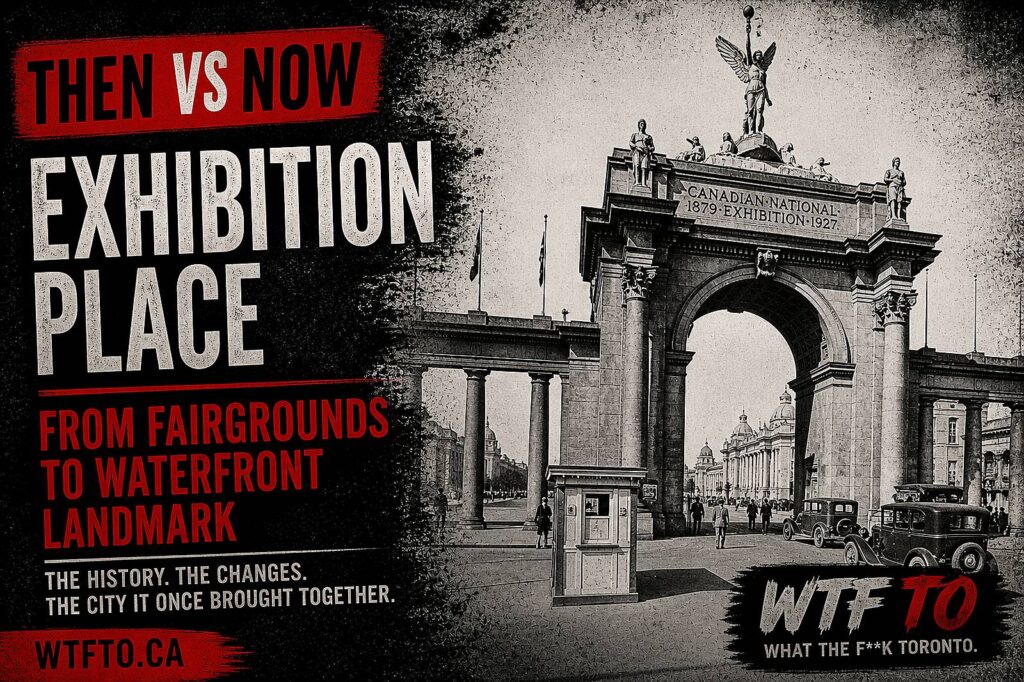
There was a time when Exhibition Place didn’t feel like a destination. It felt like the centre of the city.
Long before it became a place you visited for a concert, a game, or a weekend event, Exhibition Place was something else entirely.
It was where the city gathered.
In the late 1800s, when Toronto was still forming its identity, the grounds along the waterfront were used for agricultural and industrial exhibitions, not just for entertainment, but out of necessity. This was a time when farming, machinery, and trade were not distant industries. They were part of everyday life. People came to see livestock, yes, horses, cattle, prize animals, but also to compare, to learn, and to improve what they themselves were doing.
The exhibition was not just something to look at, it was something you participated in.
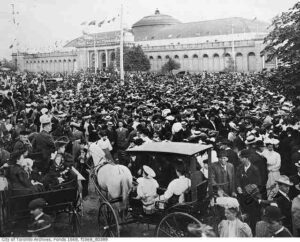
And for Toronto, it was central.
Not just geographically, but culturally. It was one of the few places where the entire city, and much of the surrounding region, came together in one space. You did not need a special reason to be there. The exhibition itself was the reason
The Canadian National Exhibition (1879 to Present)
Originally founded as an industrial fair, the CNE quickly became a showcase for agriculture, innovation, and community life, blending necessity with celebration in a way few events do today.
As the years passed, that sense of purpose began to blend with something else, enjoyment.
What started as a practical exhibition slowly took on the feeling of an annual tradition. People still came for the displays, but they also came for the atmosphere. Food vendors appeared.
Games and attractions grew. Music, performances, and exhibitions expanded beyond necessity into entertainment.
The grounds evolved with it.
Temporary structures gave way to permanent buildings. Open fields became defined spaces. What had once been assembled each year began to take on a lasting shape, something that could hold the weight of the crowds it was drawing.
And then came the gates.
Princes’ Gates (1927)
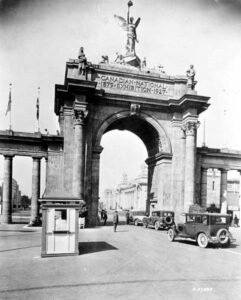
Walking through those gates meant something.
You were not just entering a fairground anymore. You were stepping into a place that had become part of the city’s identity, a space that people recognized, returned to, and remembered. For many, it became a marker of time itself. Summers were measured by it. Years were remembered through it.
The exhibition was not just an event.
It was a tradition.
Through the early and mid 20th century, Exhibition Place held a unique position in Toronto.
It was not just used. It was lived.
Outside of the major events, the grounds still felt open. People wandered. The space was not tightly controlled or narrowly defined. It allowed for movement, for gathering, for simply being there without needing a ticket or a reason.
That openness gave it something rare.
A sense of belonging.
But like much of the city, that began to change after the war.
Toronto was growing faster than it ever had before. The demand for space, structure, and infrastructure reshaped the waterfront and everything connected to it. Exhibition Place did not resist that change. It absorbed it.
Gradually, it became more organized.
More defined.
More built.
Exhibition Stadium (1959 to 1999)
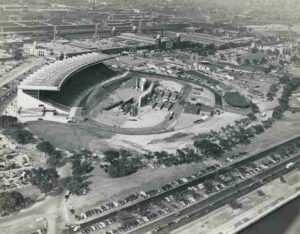
With the stadium came a different kind of crowd.
Not the steady, wandering flow of an exhibition, but focused surges of people arriving for a specific event, staying for a fixed period, and then leaving. The grounds adapted to accommodate this. More parking. More structure. More boundaries.
The flexibility that once defined the space began to narrow.
It did not disappear.
But it changed.
By the late 20th century, the transformation was undeniable.
Exhibition Place still carried its history. The buildings were still there. The CNE still returned each year, bringing back a glimpse of what the space once felt like. But outside of those moments, it no longer held the same role in the city’s everyday life.
It had become something you went to, not something you passed through.
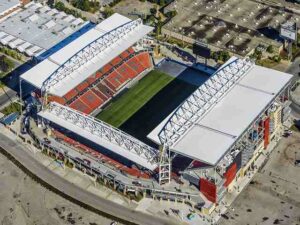
BMO Field (2007 to Present)
Replacing the old stadium, BMO Field represents the modern phase of Exhibition Place, purpose built, event focused, and aligned with a city that organizes space around specific uses.
Today, Exhibition Place is active in a different way.
It hosts events. It brings people in. It serves a purpose.
But it does not feel as open as it once did. You do not arrive without intention. You do not wander without direction. The space is defined by what is happening there at any given moment.
And when nothing is happening, it can feel almost quiet, not empty, but waiting.
And that is where the contrast settles in.
There was a time when Exhibition Place felt like part of the city’s natural flow, a place where people gathered not just because something was happening, but because it existed as a shared space.
A place where necessity turned into tradition.
Where work, learning, and community all met in one place.
Now, it is something more structured.
More specific.
Toronto did not lose Exhibition Place.
It just changed what it expects from it.
It is still there.
But it no longer feels like the place where everything came together.
0 Comments
be respectfulNo comments yet. Start the discussion.