



The Great Fire That Burned Toronto Into the Modern Age
Toronto did not become a modern city because it calmly planned ahead. That would be giving it far too much credit. Toronto…
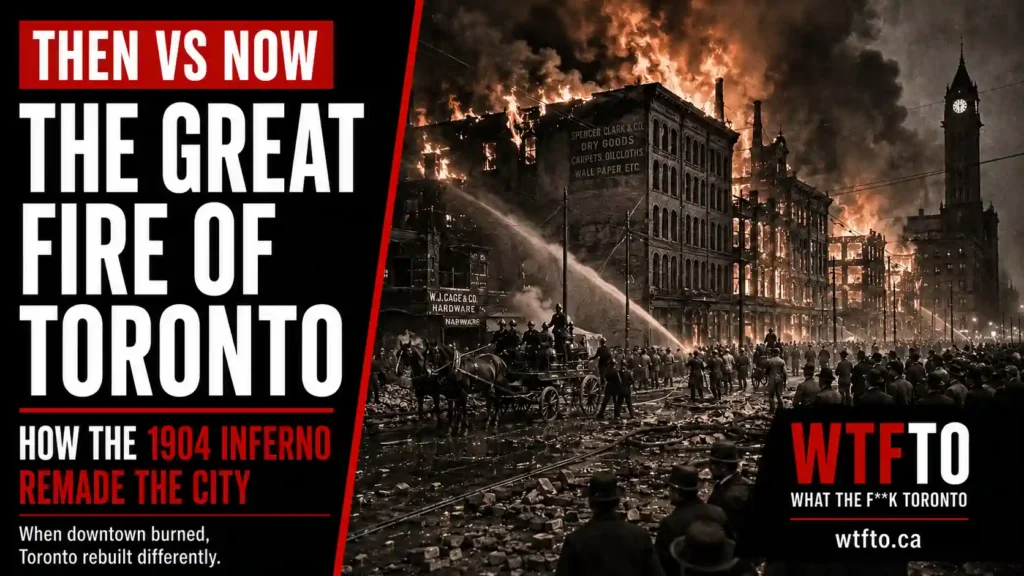
Toronto did not become a modern city because it calmly planned ahead.
That would be giving it far too much credit.
Toronto became modern the way Toronto often learns anything important: something went wrong, the damage was enormous, everyone looked shocked, and suddenly the rules, money, equipment, and urgency that had apparently been “complicated” the week before became very available.
On Tuesday, April 19, 1904, the lesson arrived as fire. The alarm was sounded at about 8:40 p.m., after flames were discovered in the E. & S. Currie Building on Wellington Street West, just west of Bay Street — one building, one alarm, one downtown block packed with paper, cloth, dry goods, wooden interiors, open stairwells, and all the confidence of a city that looked solid from the outside but was dangerously flammable on the inside.
Toronto’s commercial core was booming.
It was also, in several important ways, a giant matchbox wearing a brick coat.
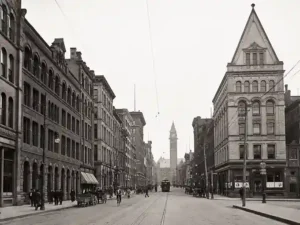
The fire did not announce itself as history at first.
It started the way disasters often do — as a problem inside one building, on one street, on one ordinary Tuesday night. Then it found the wooden floors. Then the open stairwells. Then the paper, cloth, boxes, stockrooms, and tightly packed buildings around it. By the time Toronto understood what it was dealing with, the fire was no longer a building fire.
It was a downtown fire.
The fire began in the E. & S. Currie Building on Wellington Street West, just west of Bay Street — a warehouse in the middle of a district that was already carrying too much risk under one roof. The exact cause was never proven. Some suspected faulty electrical wiring. Others wondered if a stove had been left burning after the workday. But the fire did not care which explanation would look better in the newspaper. It had fuel, space, wooden interiors, and a downtown full of buildings standing close enough to share each other’s bad decisions. By the time flames were spotted and the alarm was sounded, Toronto was not dealing with a small incident anymore. It was watching the first piece of its commercial core go up — and the next piece was already waiting.
From there, the fire spread with the confidence of something that had found exactly what it needed. It moved north, south, and east, chewing through warehouses and offices while firefighters tried to hold lines that kept shifting under them. Soon, both sides of Wellington Street and Bay Street were burning. By around 9 p.m., every Toronto firefighter was already at the scene, which sounds impressive until you remember that “everyone is here” is not comforting when the fire is still getting bigger. Toronto had reached the awful moment every growing city dreads: the disaster was larger than the system built to stop it.
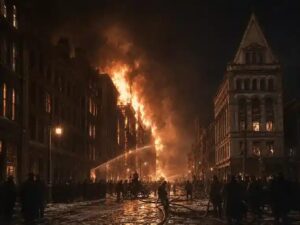
The buildings did not just burn. They helped the fire travel. Brick and stone façades gave the district the appearance of strength, but inside, many of those buildings were still full of wooden floors, wooden joists, open stairwells, and stacked goods that might as well have been waiting for their cue. Paper, fabric, boxes, dry goods, packaging, office records — the ordinary materials of business became the fire’s inventory. Open stairwells pulled flames upward like chimneys. Windows broke. Walls failed. Wires fell into the streets. Firefighters were not simply fighting flame; they were fighting a downtown that had been built to look permanent while quietly giving fire every possible advantage.
By about 11 p.m., the fire had reached Front Street. The northern advance was being held, but the flames kept pushing south and east, moving toward the Esplanade and along Front toward Yonge Street. That mattered because Yonge was not just another street. It was the line Toronto could not afford to lose. If the fire crossed farther east, the disaster could have rewritten even more of downtown before sunrise. So firefighters made their stand just west of Yonge, soaking buildings, climbing roofs, holding positions, and doing the grim math of urban disaster: save this block, lose that one, stop the next wall from becoming the next torch.
For hours, the city fought a moving wall of heat with whatever it could throw at it. Some firefighters worked from the street. Others climbed onto the roofs of buildings that had not yet burned, trying to drown the fire line before it could leap again. Workers at the Evening Telegram building helped protect their own building and slow the fire’s eastward push. It was not neat. It was not heroic in the polished bronze-plaque way. It was desperate, dangerous, exhausting work — men standing between a burning downtown and the rest of the city, hoping the water, the walls, and their luck would hold until morning.
Around 4:30 in the morning, the fire was finally declared under control. Not finished. Not gone. Just controlled — which, after a night like that, was probably the closest Toronto could get to good news. The flames had been stopped before they could keep marching east, but the ruins were still hot, unstable, and dangerous. Small fires continued to flare up. The wreckage smouldered for days, and in some places for nearly two weeks, as if the city itself needed time to cool down from what had just happened. By sunrise, Toronto had not simply survived a fire. It had been handed a warning in smoke, brick, ash, and unpaid consequences.
The numbers still feel unreal more than a century later. More than 100 buildings were destroyed or gutted. Over 125 businesses were burned out. Millions of dollars in property vanished in one night, at a time when a dollar still had the decency to mean something. About 5,000 workers were left temporarily or permanently out of work, not because the economy had shifted or a company had moved, but because their workplaces had literally disappeared into smoke. Toronto lost warehouses, printers, dry-goods firms, stationers, manufacturers, paper companies, mills, offices, inventory, machinery, records, and the kind of commercial confidence that looks very sturdy until it is lying in the street as hot brick.
And yet, somehow, the fire itself did not kill anyone, which almost feels impossible when you look at the photographs. Streets were buried in debris. Walls stood like broken teeth. Whole blocks looked hollowed out, as if the city had been scooped from the inside and left standing just long enough to be photographed. Firefighters were injured, including Chief John Thompson, who broke his leg after falling from a ladder, and the night was dangerous from every direction: smoke, cinders, collapsing structures, fallen wires, unstable walls, streets packed with hose, rubble, and men trying to work inside a disaster that kept changing shape. One worker, John Croft, later died during demolition work in the ruins, a reminder that the fire did not stop being dangerous just because the flames were finally under control. So the miracle was not that the fire was harmless. It was that Toronto came that close to losing part of its downtown, on that scale, and somehow did not lose more lives while the city burned around them.
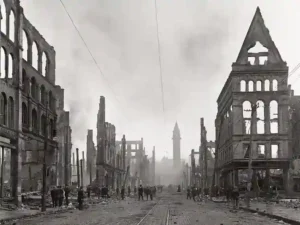
That is usually when Toronto gets serious.
Not before. Not when people warn about the risk. Not when the problem is theoretical. Toronto tends to wait until the bill arrives, preferably smoking, then discovers that reform was possible after all.
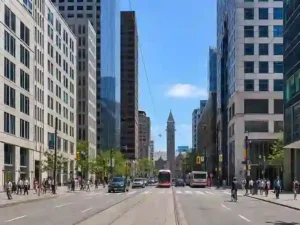
Now: Toronto’s modern Financial District and downtown commercial core
Approximate year / era: 1904
What changed: In 1904, this part of downtown Toronto was a tightly packed warehouse and commercial district filled with wooden interiors, open stairwells, paper, cloth and other flammable goods. The Great Fire destroyed or gutted more than 100 buildings, burned out over 125 businesses and left thousands of workers without workplaces. The disaster exposed major weaknesses in Toronto’s building standards, water pressure and firefighting capacity. In the years that followed, the area was rebuilt with stricter construction rules, stronger fire protection, improved equipment and better planning. Today, much of the same area forms part of Toronto’s modern Financial District and downtown commercial core.
Source / permission: Historical research based on public archival records, historical photographs and published accounts of the 1904 Great Fire of Toronto
0 Comments
be respectfulNo comments yet. Start the discussion.