



Toronto’s $380 Million FIFA Bill — And What It Really Costs
Toronto’s $380 Million FIFA Bill – And What It Really Costs
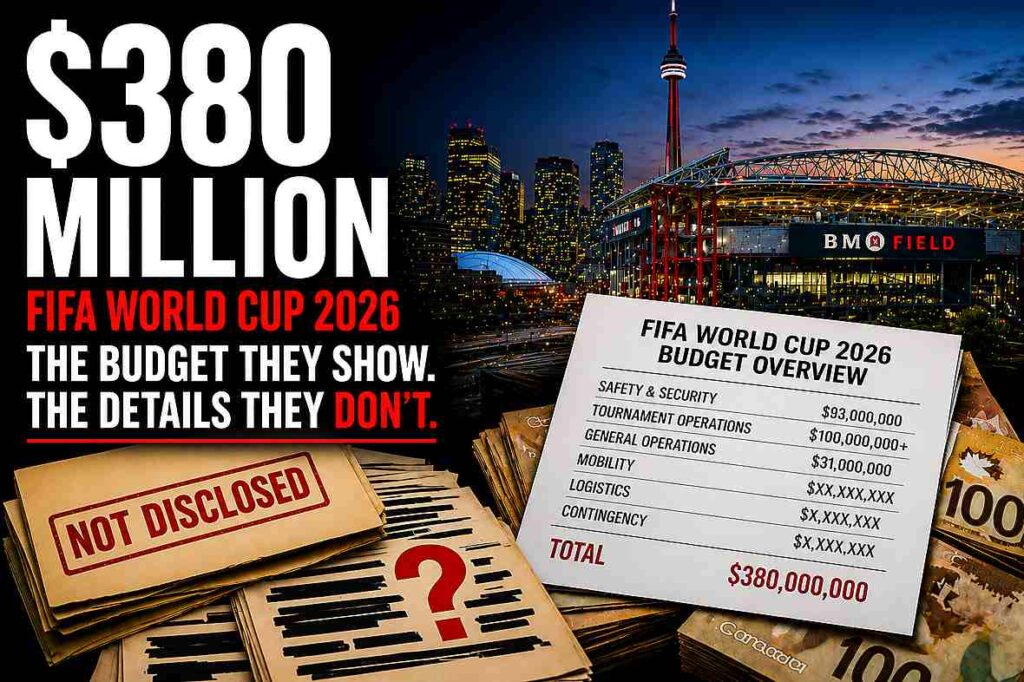
Toronto knows exactly how much the 2026 FIFA World Cup will cost: $380 million. It’s a number that has been repeated often, confidently, and without hesitation. Clean. Simple. Controlled.
But the moment you move past that headline figure, the clarity begins to fade. What replaces it isn’t detail – it’s distance.
On paper, the City presents the FIFA budget as organized and structured, dividing spending into categories that sound official and reassuring: safety and security, tournament operations, general operations, mobility, logistics, contingency. It looks like a plan and reads like a plan. But those categories are not explanations. They are labels. They tell you what kind of spending exists, not how the money is actually being spent. There is no clear, consolidated breakdown showing how many people are being paid, what contracts are worth, or how the final number was built. The public is given the total, but not the receipt.
The largest portion of the operating budget sits under “safety and security,” at roughly $93 million. The City says this includes policing, fire services, emergency response, and venue security. All of that sounds necessary. None of it sounds controversial. But for a number that large, the explanation stops far too early. There is no clear public accounting of police overtime, no detailed estimate of how many officers are being deployed, no breakdown of private security contracts, and no distinction between labour, equipment, and infrastructure. The biggest number in the budget is also the least defined.
The same pattern repeats itself under “tournament operations,” another massive category that absorbs tens of millions more. This is where transportation planning, stadium operations, and event coordination live. It is also where clarity disappears completely. “Operations” is one of the most flexible words in government spending. It can mean buses and road closures, or it can mean consultants, temporary staff, infrastructure, signage, and logistics coordination. It can mean almost anything – and when everything fits inside the same category, nothing can be properly examined.
Toronto also allocates about $31 million to general operations – communications, management, government relations, and protocol. Again, nothing about those functions is unusual. But the number raises a simple question: how does the City arrive at $31 million? There is no staffing model presented to the public, no breakdown of internal versus external costs, and no visibility into consultant fees or administrative structure. There is only the final figure, detached from the calculation behind it.
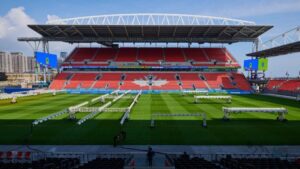
To be fair, not every part of the FIFA budget is this vague. The stadium upgrades are one of the few areas where the City actually shows its work. Roughly $132.9 million is being spent on tangible improvements – accessibility upgrades, dressing rooms, video boards, lighting, and turf. These are visible investments. You can point to them. You can understand what is being built. And that clarity only makes the lack of detail elsewhere more obvious.
Because alongside those permanent upgrades is one of the most telling decisions in the entire plan: temporary seating. To meet FIFA’s requirements, Toronto is installing modular seating structures that expand the stadium for the tournament. These structures will be built, used, and then removed once it’s over. They are not a long-term expansion. They are a temporary solution.
There are practical reasons for that. The city may not need a larger stadium once FIFA leaves, and permanent expansion brings long-term maintenance costs and political complications. Temporary seating is faster, more flexible, and easier to justify in the short term. But from a financial perspective, it raises a harder question: why spend tens of millions on infrastructure designed to disappear?
That question becomes harder to ignore once you move beyond the categories and start following the money that has actually been disclosed. Because what emerges is not a clear budget, but a network.
One of the largest contracts goes to AES Canada Corp., which has been awarded tens of millions of dollars to build out that temporary stadium capacity – roughly $30 million for seating and another $19 million for hospitality structures. Built for the event, then removed. Gone. This is not long-term infrastructure; it is event-specific spending tied directly to FIFA’s requirements.
The same pattern appears in the fan festival, the public-facing centerpiece of the event. That contract went to Fifth Social Club, starting at around $16 million before growing by another $9 million to roughly $25 million. For a viewing space. A place to watch games and run programming. The justification is always the same – expanded experience, enhanced programming, operational needs – but those aren’t breakdowns. They are phrases. They explain why the number exists, not how it was built.
Toronto even tested how far that logic could go.
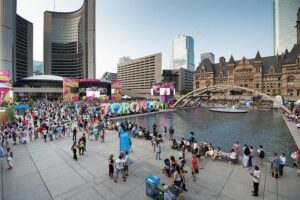
The fan festival – originally promoted as a free, open public event – was suddenly tied to a proposed $10 entry fee. The justification was familiar: crowd control, cost recovery, a better experience. But the reaction was immediate. Councillors pushed back, and the public pushed back harder. Charging residents for something already funded through public money didn’t land. City Hall reversed course. General admission went back to free.
That moment matters, because it shows exactly where the tension is.
The cost doesn’t go away – but the moment it becomes visible, the moment people are asked to pay directly, it becomes a problem.
Consultants follow the same pattern. Firms like Gensler and CAA ICON are being paid millions to design, manage, and coordinate the project, while planning extends into healthcare, with millions going to Sunnybrook Health Sciences Centre for medical preparedness. Individually, none of this is surprising. Large events come with large teams. But taken together, it paints a different picture. This isn’t just a tournament. It’s a system of contracts.
And even after adding those contracts together, something still doesn’t add up. What has been disclosed accounts for only part of the $380 million. The rest remains buried inside those same broad categories – security, operations, staffing, logistics – without clear breakdowns. That’s where the largest costs sit, and that’s where the trail disappears.
There is no clear public accounting for police overtime, no detailed explanation of deployment levels, no full picture of private security contracts. Staffing numbers remain unclear. Vendor agreements are scattered. Layers of consulting and coordination exist without a single place where they come together. What the public gets are fragments – pieces of the puzzle, but never the full picture.
Part of that is structural. Procurement rules allow for delayed disclosure, and some contract details remain confidential until after they are awarded. By the time the public sees the deal, it has already been signed and the money has already moved.
And that brings it back to the most visible example of all: temporary seating. Tens of millions of dollars. Built. Used. Removed. Gone. It exists because FIFA requires it, not because Toronto needs it. Not because it strengthens the city long-term, but because for a few weeks, the capacity has to be there. The city builds something it knows it won’t keep. That’s not legacy. That’s compliance.
From a distance, the FIFA budget looks complete. Up close, it’s something else entirely. You can see enough to know the money is real, enough to identify some of the companies involved, enough to confirm that millions are being spent – but not enough to follow the full trail from start to finish.
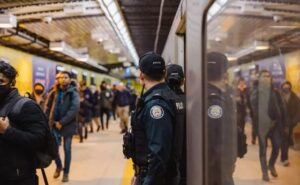
Toronto hasn’t hidden the cost of the World Cup. It has done something more subtle. It has shown the number, shown parts of the spending, and left the rest buried inside the system.
And even beyond the budget itself, the cost continues to spread. Through taxes, through price increases, through the way the city shifts around the event. The bill doesn’t disappear – it gets distributed.
Which brings it back to the only question that matters.
Was it worth it?
There is a strong case to say yes. This is the World Cup – one of the largest global events in existence. For a few weeks, Toronto will be on screens around the world, reaching audiences that cities typically spend years trying to access. There is economic activity, there are jobs, there are lasting upgrades, and there is momentum that comes with being part of something global.
But the benefits are broad. The costs are specific.
Toronto made a choice – to spend heavily, to take on risk, and to host something global. And like any major investment, the outcome won’t be decided during the event. It will be decided after, when the crowds leave and the city returns to normal.
That’s when the answer becomes clear.
0 Comments
be respectfulNo comments yet. Start the discussion.